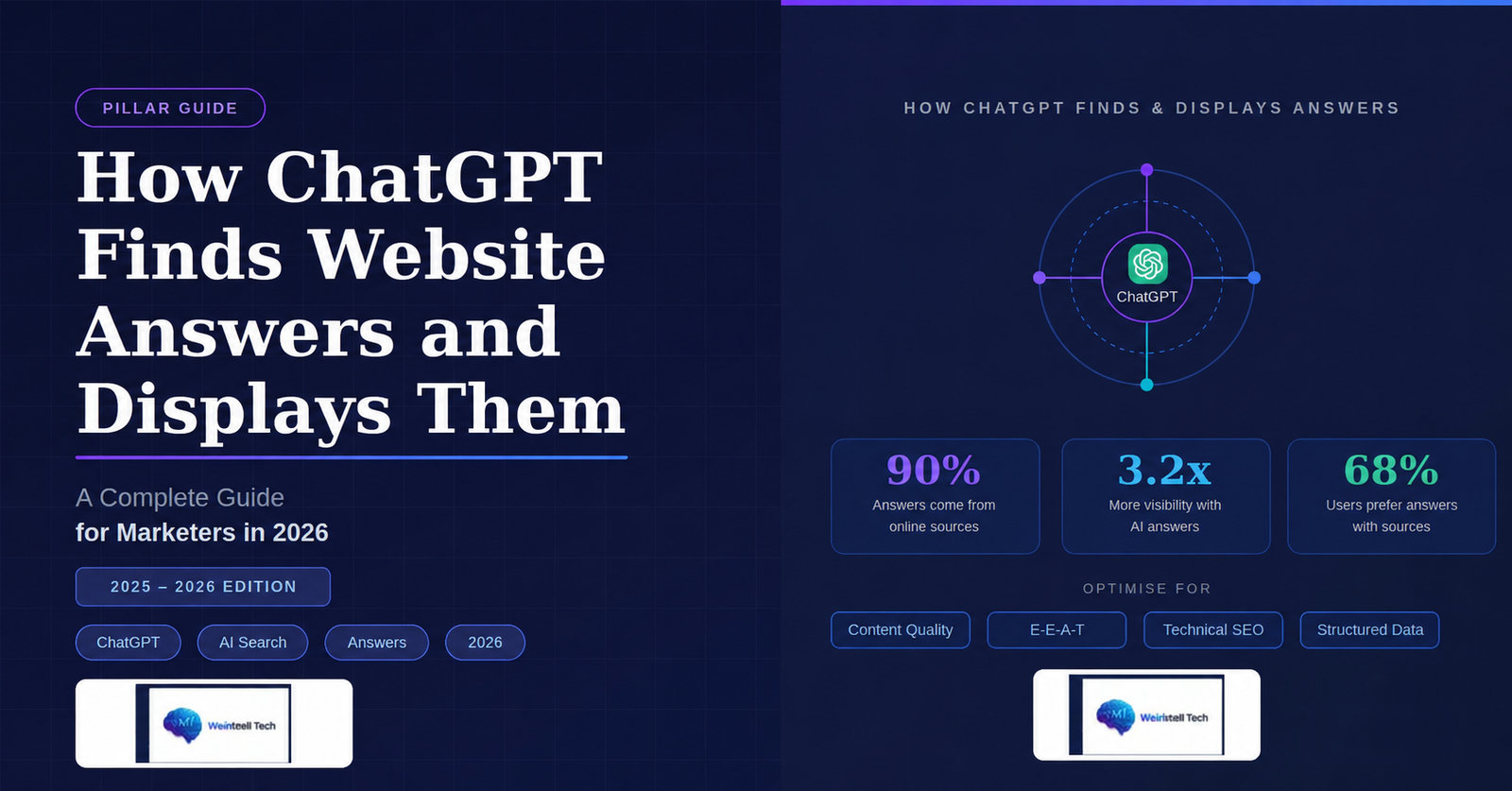
You’ve asked ChatGPT a question. Seconds later, it delivers a confident, well-structured answer — and right at the bottom, there’s a list of source links pointing to specific websites. One thought crosses your mind: how did ChatGPT Finds Website Answers to cite those websites and not mine?
This is no longer just a curiosity. With ChatGPT crossing 800 million weekly active users in 2026, the websites that get cited by AI engines are capturing a new wave of organic, high-intent traffic. Meanwhile, websites that ignore Answer Engine Optimization (AEO) are slowly becoming invisible — even if they rank well on Google.
In this in-depth guide, you’ll discover exactly how ChatGPT retrieves content from the web, how it decides which sources to cite, how it formats answers for display, and — most importantly — what you need to do to become one of those cited sources. Every section includes actionable strategies you can implement today.
Table of Contents
- How ChatGPT “reads” the internet
- The two modes: Training data vs. live browsing
- The 4-step retrieval pipeline explained
- How ChatGPT formats and displays answers
- The 6 signals that get your site cited
- Step-by-step: How to optimize for ChatGPT citations
- 7 common mistakes that block ChatGPT citations
- Key takeaways + free AEO checklist
1. How ChatGPT “Reads” the Internet
To understand how ChatGPT cites your website, you first need to understand how it learned everything it knows. ChatGPT is a Large Language Model (LLM) — specifically OpenAI’s GPT-4 series — trained on a massive corpus of text scraped from the internet, including books, academic papers, news articles, blog posts, product pages, forums, and documentation.
During training, ChatGPT didn’t just memorize a dictionary of facts. It learned patterns of language: how questions are typically asked, what authoritative answers look like, how different topics relate to each other, and which writing styles signal trustworthiness. The model essentially absorbed the “shape” of human knowledge as expressed in text.
A key source of this training data is Common Crawl — a nonprofit that continuously crawls the web and makes the data publicly available. OpenAI uses Common Crawl (along with curated datasets like WebText, Wikipedia, and books) to build the training corpus. This means that the quality, clarity, authority, and reach of your website content directly influence whether it ends up in training data.
Think of training data as ChatGPT’s long-term memory. When you ask it a question that doesn’t require live browsing, it generates an answer from this internal knowledge base — no internet connection required. Your site being in this “memory” is powerful, but it takes time and sustained content quality to achieve.
“The websites that ChatGPT cites are not just the ones with the best SEO scores — they’re the ones written with the highest clarity, the deepest specificity, and the most direct answer to the question being asked.” — Core principle of Answer Engine Optimization
2. The Two Modes: Training Data vs. Live Browsing
Here’s what most SEOs and content marketers miss entirely: ChatGPT can access your website in two completely different ways. Your AEO strategy needs to account for both.
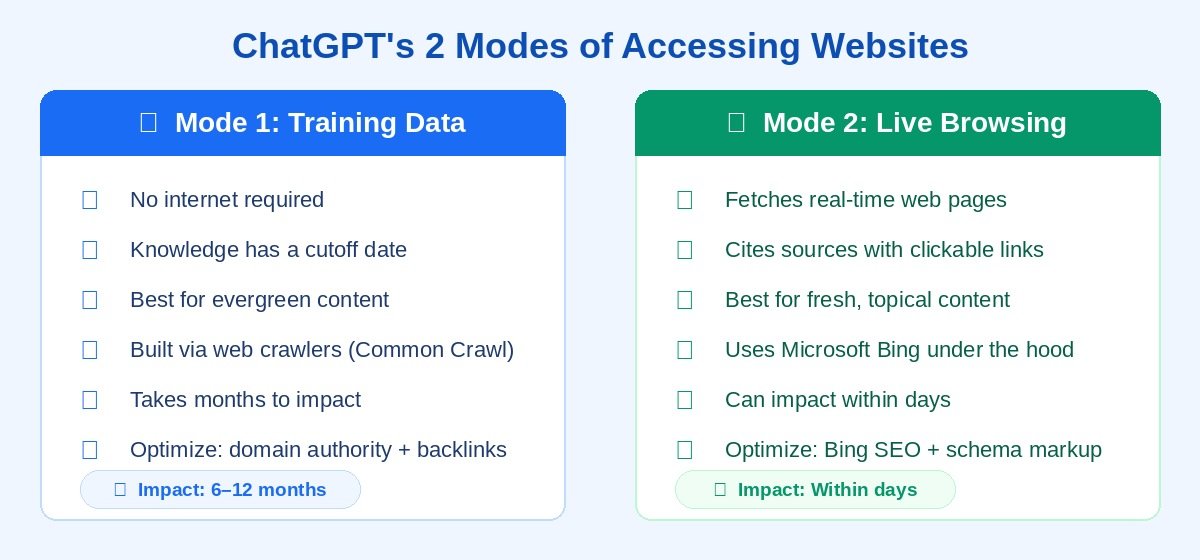
Mode 1 — Training Data (Offline Knowledge)
When ChatGPT answers a question from its base model – without the web browsing tool enabled – it draws entirely on knowledge absorbed during training. This is a static snapshot with a knowledge cutoff date. Content published after that cutoff is invisible to this mode.
For your content to make it into training data, your site must have been crawled by web scrapers before the training cutoff. The factors that determine whether your content gets included and weighted heavily are: domain authority, inbound link profile, content quality scores, how widely your content was shared or referenced, and whether it appeared on high-authority sites that link to you.
This mode is where evergreen content — cornerstone guides, comprehensive tutorials, definitional articles — has the highest long-term payoff. A well-written, extensively cited guide published today could become part of GPT-6’s training data two years from now, permanently embedding your brand into the model’s knowledge.
AEO Tip for Mode 1: Build consistent, comprehensive, well-cited content over time. Gain backlinks from high-authority sites. Publish content that other websites reference and quote. This is how you get embedded into future training datasets – making your brand a permanent fixture in AI model knowledge.
Mode 2 — Live Browsing (Real-Time Retrieval)
In 2023, OpenAI gave ChatGPT the ability to browse the web in real time through its browsing tool — and this changes the game entirely. When a user asks a timely question, searches for current information, or explicitly triggers a web search, ChatGPT fetches live web pages, extracts the most relevant content, and cites those sources directly in its response.
This is where immediate AEO optimizations pay off fast. A well-optimized page published today can be cited by ChatGPT within days — not months. This mode operates through Microsoft Bing (more on this in Section 3), which means your Bing visibility is critical infrastructure for your AEO strategy.
Common Misconception: Many marketers assume ChatGPT only uses its training data. In reality, ChatGPT Plus and ChatGPT in agentic workflows use live web browsing for most informational queries. If you’re not optimizing for live retrieval, you’re leaving the majority of citation opportunities on the table.
3. The 4-Step Retrieval Pipeline Explained
When ChatGPT browses the web (Mode 2), it follows a structured retrieval pipeline. Understanding each step gives you precise leverage points to optimize your content for citation.
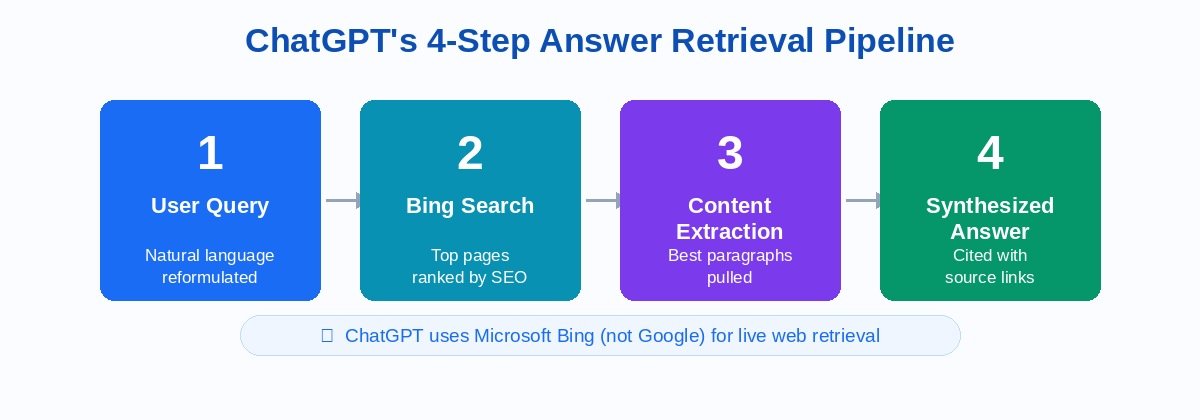
Step 1 — Query Reformulation
ChatGPT doesn’t send the user’s raw conversational question directly to a search engine. It first reformulates the query into a cleaner, more specific search phrase. For example, if a user asks, “I want to invest money, but I’m scared of losing it, what should I do?”, ChatGPT might internally generate the query “safe investment options for risk-averse investors India 2026” — stripping away the emotional language and focusing on the core informational intent.
This reformulation is critical for your content strategy. Your content needs to match not just how users speak, but how ChatGPT interprets and searches for that intent. Writing content that addresses the underlying question, not just the surface phrasing, dramatically improves your chances of being retrieved.
Step 2 — Bing Search and Result Ranking
Here is the most important technical fact in this entire article: ChatGPT’s live browsing tool uses Microsoft Bing, not Google, as its search backbone. This is the result of Microsoft’s multi-billion-dollar partnership with OpenAI that began in 2023 and continues in 2026.
Bing returns a ranked list of results based on standard SEO signals: domain authority, keyword relevance, page freshness, structured data markup, page speed, and mobile-friendliness. This is why Bing SEO — which most marketers completely ignore — is now a direct lever for ChatGPT citation rates.
Action Required — Most Marketers Miss This. If your sitemap is not submitted to Bing Webmaster Tools, ChatGPT’s browsing tool may never find your pages. Go to bing.com/webmasters right now, verify your site, and submit your XML sitemap. This single step can open up ChatGPT citation opportunities immediately.
Step 3 — Page Content Extraction
ChatGPT doesn’t read your entire website. It selects 3–7 top-ranked pages from Bing and then extracts specific sections — typically the most relevant paragraphs that appear immediately below a matching heading. The model is essentially scanning for the “best answer to this query” within the first few hundred words of each section.
Pages with clear H2/H3 headings, short answer paragraphs at the top of each section, bullet-point lists, and structured data are dramatically easier for ChatGPT to parse correctly. Dense walls of text, poor heading structure, and buried answers all reduce your chance of being extracted and cited.
Step 4 — Synthesis and Citation Display
Finally, ChatGPT synthesizes information from the 2–5 best sources into a single coherent, well-structured answer. It then displays those sources as citations in the response. The sources chosen for citation are not purely ranked by SEO position — they’re selected based on which pages provided the clearest, most directly usable content for the specific answer being generated.
This means a page ranked #5 on Bing with exceptional content structure can outrank a #1 page with poor answer clarity in terms of ChatGPT citations. This is the opportunity that AEO unlocks.
4. How ChatGPT Formats and Displays Answers
Understanding the output format matters just as much as understanding the retrieval process — because the way ChatGPT displays answers directly mirrors the content structures it prefers to extract from. Align your content format to these output patterns and you’ll see significantly higher citation rates.
Snippet-Style Direct Answers
For factual, definitional, or “what is” queries, ChatGPT delivers a clean 2–4 sentence direct answer at the top of its response. These snippets are almost always sourced from pages that had a clear, concise definition or summary paragraph in the first 100–150 words of a heading section. If your article buries its definition in paragraph 5 after a long introduction, ChatGPT will skip it for a competitor that leads with the answer.
Numbered Steps and Bullet Points
For “how to” and process-based queries, ChatGPT presents numbered step-by-step instructions or bullet-point summaries. It often reformats content from multiple sources into this structure, but pages that already use numbered lists and clear bullets are cited far more frequently because the extraction is cleaner and more reliable.
Comparison Tables
When users ask comparison questions (“X vs Y”, “best tools for Z”), ChatGPT frequently generates structured comparison tables by pulling data from multiple sources. Pages that include explicit comparison tables with schema markup, or clearly labeled side-by-side sections, are significantly more likely to be cited as the data source for these answers.
Sources Block With Clickable Links
When ChatGPT’s browsing tool is active, responses include a “Sources” section at the bottom with 2–5 clickable links to the pages it cited. This is direct referral traffic. Users who see their question answered well and want to go deeper often click these links — making ChatGPT citations a meaningful and growing traffic channel, not just a visibility metric.
5. The 6 Signals That Get Your Site Cited by ChatGPT
Through systematic analysis of ChatGPT citation patterns, six content and technical signals consistently separate cited pages from uncited ones. Master all six to maximize your AEO performance.
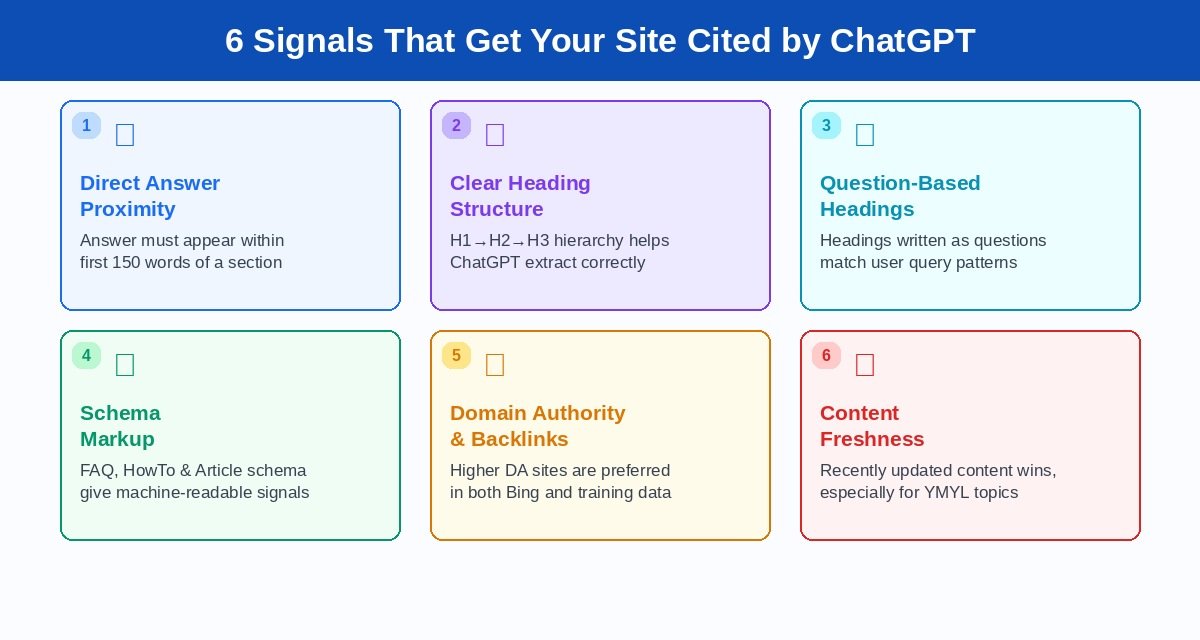
- Direct Answer Proximity- The single most important signal. The direct answer to the section’s implied question must appear within the first 100–150 words after the heading — not buried after paragraphs of context. ChatGPT scans the opening of each section and makes a rapid judgment on relevance. Lead with the answer. Explain after.
- Clear Heading Hierarchy- A logical H1 → H2 → H3 structure isn’t just good UX — it’s how ChatGPT understands your content’s semantic architecture. Each heading should clearly signal the topic of the section beneath it, enabling precise extraction. Ambiguous or creative headings (“The Magic Formula”) confuse the model; specific ones (“How to Calculate Your EMI”) guide it perfectly.
- Question-Based Headings- Headings written as questions (“How does ChatGPT find answers?”, “What is the best way to invest ₹10,000?”) directly mirror how users phrase queries to ChatGPT. This alignment between your heading and the user’s search query creates a strong semantic match signal that dramatically improves retrieval rates.
- Schema Markup Implementation- FAQ Schema, Article Schema, and HowTo Schema provide machine-readable signals to Bing and ChatGPT about the structure and intent of your content. Pages with FAQ schema are particularly effective because the question-answer pairs are explicitly marked up, making extraction trivially easy for the model.
- Domain Authority and Backlinks- Higher domain authority sites rank better on Bing, and pages with more quality backlinks signal to the model that the content is widely recognized as authoritative. Building your backlink profile through genuine value — original research, comprehensive guides, data-driven posts — remains one of the highest-leverage AEO investments.
- Content Freshness and Update Signals- For topics where accuracy matters — finance, health, technology, legal — ChatGPT strongly prefers recently updated content. Display a clear “Last updated” date near the top of key pages. Regularly refresh statistics, examples, and links in your top-performing content. This signals to both Bing and the model that your information is current and reliable.
🎓 AEO Mastery Course
Want to Rank in ChatGPT, Perplexity & Google AIO?
My complete AEO e-book covers everything — schema markup code, prompt-match content templates, 30-day action plan, and real optimization frameworks used by top-ranking sites in 2026. Built specifically for bloggers, marketers, and SEOs in India and worldwide.
👉 Get the AEO E-Book on Gumroad
6. Step-by-Step: How to Optimize Your Content for ChatGPT Citations
Now that you understand the retrieval mechanics and the signals that matter, here is a concrete, actionable framework for optimizing every piece of content you publish — whether you’re writing a new article or updating an existing one.
Phase 1 — Content Architecture (Before You Write)
Before writing a single word, identify the primary question your page answers. This question should be: specific enough to match real user queries, broad enough to support 1500+ words of comprehensive coverage, and directly relevant to your niche and audience. Write it down. Make it your North Star for the entire piece.
Next, map out your H2 subheadings — and write every single one as a question. Example: instead of “Benefits of SIP Investment,” write “What Are the Benefits of SIP Investment?” This structural choice alone will significantly improve your ChatGPT retrieval rate because it creates direct alignment between your headings and the queries users type into AI engines.
Phase 2 — The “Answer First” Writing Method
For each H2 section in your article, follow this three-part structure religiously:
- Direct Answer Paragraph (40–60 words): Immediately below the H2, write a crisp, complete answer to the heading question. No preamble. No “In this section we will explore…” Just the answer.
- Supporting Context (100–300 words): Now provide the background, evidence, examples, and nuance that supports and expands on your direct answer.
- Actionable Takeaway (1–3 bullets): Conclude each section with 1–3 specific, actionable points the reader can apply immediately.
This structure serves double duty: it makes your content more useful for human readers, and it makes your content optimally structured for AI extraction. Both outcomes compound each other — higher reader engagement signals improve your Bing rankings, which in turn improves your ChatGPT citation rate.
Phase 3 — Technical AEO Implementation
After writing, implement these technical optimizations before hitting publish:
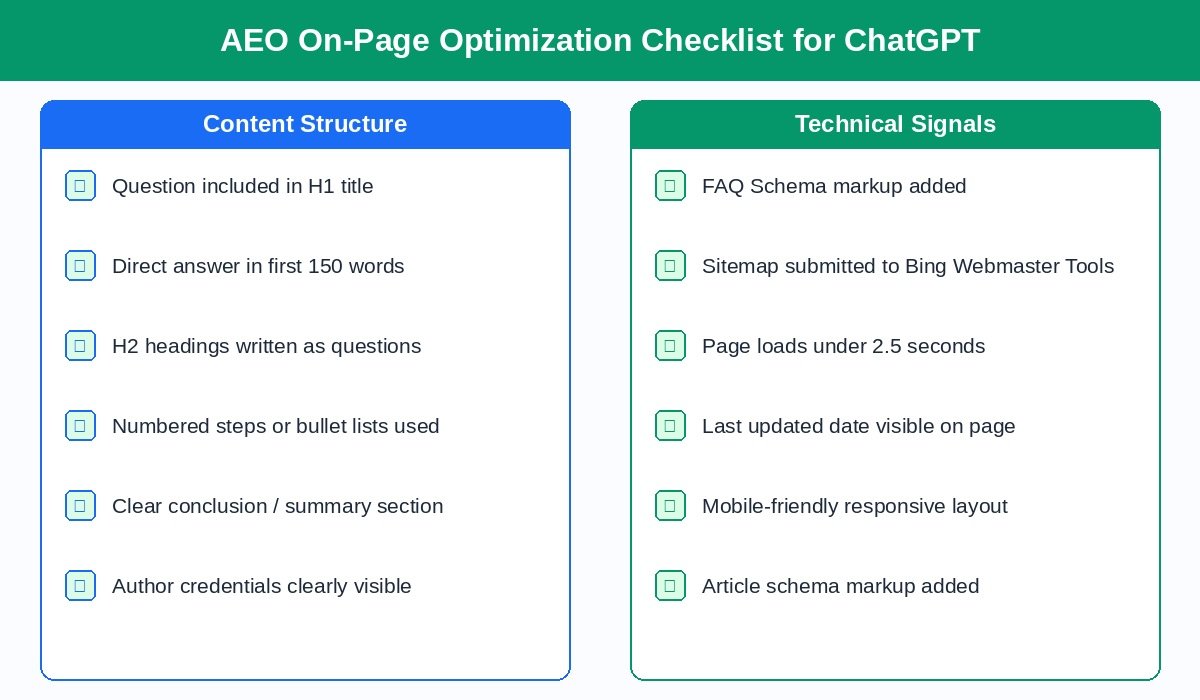
- Add FAQ Schema to every page with question-and-answer content. In WordPress, use Rank Math’s FAQ block or Yoast’s FAQ block- both generate a valid FAQ schema automatically.
- Add Article Schema with author information, publication date, and last-modified date. This satisfies EEAT signals that both Bing and AI models evaluate.
- Submit to Bing Webmaster Tools. If you haven’t already, go to bing.com/webmasters, verify your site, and submit your XML sitemap. Check your Bingbot crawl logs monthly.
- Optimize page speed to load under 2.5 seconds. Use Google PageSpeed Insights to identify and fix Core Web Vital issues — Bing factors these into rankings just as Google does.
- Add a visible “Last Updated” date near the top of every key article. This freshness signal matters significantly for YMYL (Your Money Your Life) topics.
- Write a comprehensive author bio with specific credentials, years of experience, and links to published work. Anonymous content is increasingly deprioritized by both search engines and AI models.
7. The 7 Common Mistakes That Block ChatGPT Citations
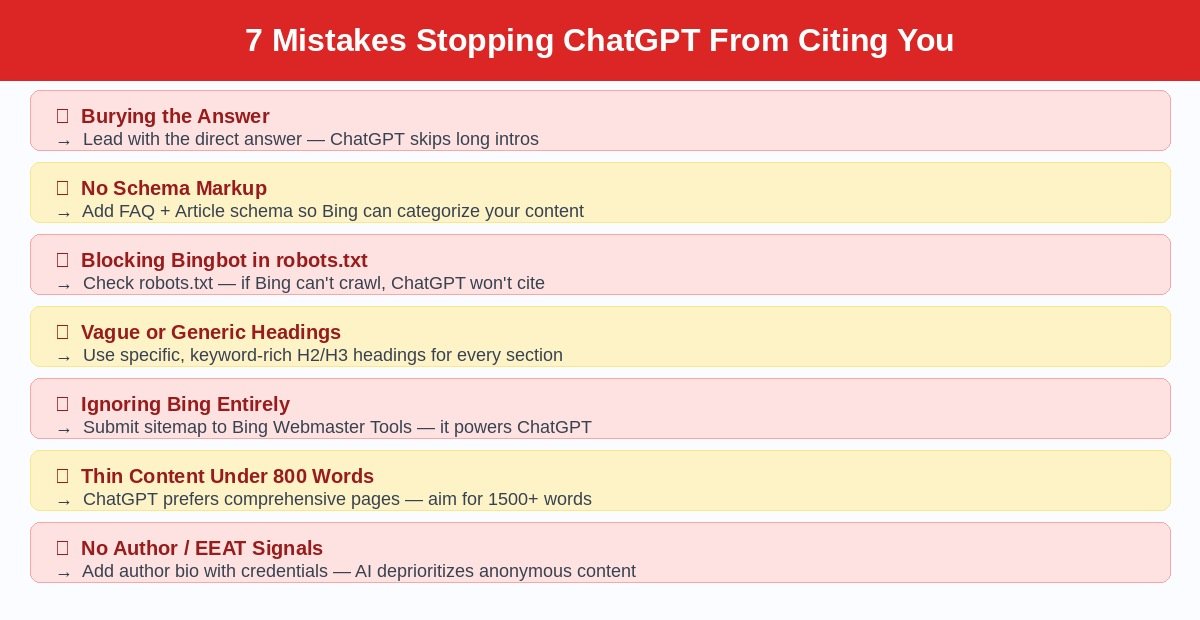
Even well-written, well-ranked pages are often never cited by ChatGPT. Here are the most common reasons why — and the precise fix for each.
| Mistake | Why It Kills Your AEO | The Fix |
| Burying the answer | ChatGPT scans section openings; buried answers are skipped entirely | Lead every section with a direct 40–60 word answer paragraph |
| No schema markup | Bing can’t categorize your content type; extraction is unreliable | Add FAQ, Article, and HowTo schema via Rank Math or Yoast |
| Bingbot blocked in robots.txt | If Bing can’t crawl your page, ChatGPT’s browsing tool won’t find it | Audit robots.txt and ensure Bingbot is allowed on all key pages |
| Vague or creative headings | ChatGPT can’t map sections to specific queries without clear headings | Rewrite all H2/H3 headings as specific, keyword-rich questions |
| Google-only optimization | Ignoring Bing = ignoring the engine that powers ChatGPT live browsing | Submit sitemap to Bing Webmaster Tools; monitor Bing performance monthly |
| Thin content under 800 words | Short pages rarely provide enough signal or depth for citation | Aim for 1500–3000 words with comprehensive, specific coverage |
| No EEAT / author signals | AI systems increasingly deprioritize anonymous content on YMYL topics | Add detailed author bio with credentials, experience, and links |
The most complete AEO course available — instant download on Gumroad
Complete AEO Playbook
The AEO Course: Rank in ChatGPT, Perplexity & AI Search in 2026
This e-book is the most comprehensive, practical guide to Answer Engine Optimization available today. Built for bloggers, SEOs, and marketers who want to dominate AI-powered search. Includes plug-and-play schema code, content templates, a 30-day AEO action plan, and real case studies from sites already winning ChatGPT citations.

👉 Buy the AEO E-Book on Gumroad — Instant Download
Key Takeaways: What You Need to Remember
The shift from search engine optimization to answer engine optimization is not a distant future trend — it’s happening right now, at scale. Every day that ChatGPT answers a question without citing your site is a day your competitors gain ground in the AI search landscape.
The good news is that the optimization principles are clear, actionable, and achievable for any website — regardless of size or current authority. The sites winning ChatGPT citations today didn’t have a head start in domain authority. They had a head start in understanding how AI engines retrieve and evaluate content — and they built their content accordingly.
6 Things to Do This Week
- Submit your sitemap to Bing Webmaster Tools — this is the single fastest action you can take to open ChatGPT citation opportunities.
- Rewrite your top 5 article H2 headings as questions – this improves both semantic matching and extraction accuracy.
- Add FAQ schema to every key page – use Rank Math or Yoast to do this in under 10 minutes per page.
- Add a “Last Updated” date to your top-performing articles — freshness signals matter, especially for competitive topics.
- Audit your robots.txt file – ensure Bingbot is not blocked on any important pages.
- Write or update your author bio with specific credentials — EEAT signals directly impact AI model trust scores.
AEO Answer Engine Optimization ChatGPT SEO AI Search 2026 Bing SEO Schema Markup FAQ Schema Content Optimization ChatGPT Citations AI Traffic
Frequently Asked Questions
Does ChatGPT use Google or Bing to search the web?
ChatGPT’s live browsing tool uses Microsoft Bing, not Google. This is the result of Microsoft’s major investment in OpenAI. For your content to be found and cited by ChatGPT in real time, optimizing your Bing presence — including submitting your sitemap to Bing Webmaster Tools — is essential.
How long does it take for ChatGPT to get cited?
For live browsing citations, properly optimized content can start appearing in ChatGPT answers within a few days to weeks of being indexed by Bing. For training data inclusion (which affects offline knowledge answers), the timeline is much longer — typically tied to major model update cycles that occur every 6–18 months.
What schema markup is most important for AEO?
The three most impactful schema types for AEO are: FAQ Schema (for question-answer content), Article Schema (for blog posts and guides), and HowTo Schema (for step-by-step instructional content). All three can be implemented easily in WordPress using Rank Math or Yoast SEO.
Can a small website get cited by ChatGPT?
Yes. ChatGPT citations are not exclusively reserved for high-DA sites. A smaller website with exceptionally well-structured, directly answering content on a specific niche topic can outperform larger sites with poor AEO optimization. Specificity, clarity, and answer proximity matter as much as — sometimes more than — domain authority.
What is the ideal word count for AEO-optimized content?
For content targeting ChatGPT citations, aim for a minimum of 1500 words, with 2000–3500 being the sweet spot for comprehensive coverage. Thin content under 800 words rarely provides enough signal depth. However, word count should never replace answer quality — a focused 1500-word guide will outperform a padded 4000-word post every time.
Part of the AEO Pillar Cluster series. Read Blog #1: What is AEO? Complete Answer Engine Optimization Guide for 2026 for the full foundational overview.
WebIntelliTech Team
SEO & AEO Strategists
Ready to improve your AI search visibility?
Get a free AI visibility audit and see exactly where you stand.