
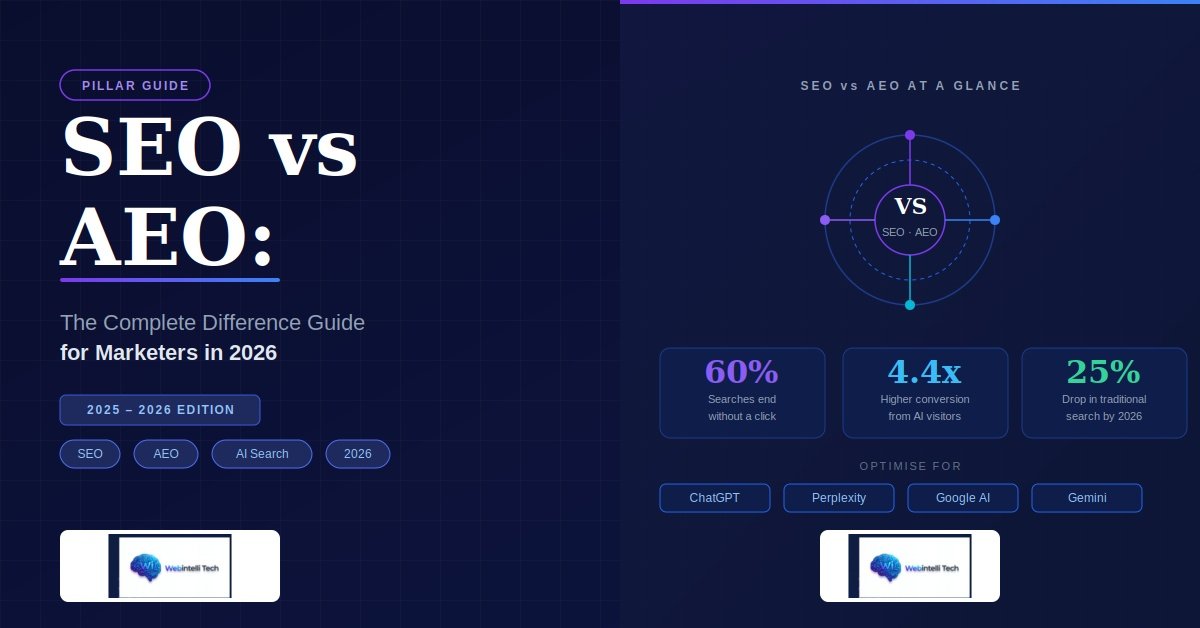
If you’ve been doing SEO for even a few months, you already sense that something has fundamentally changed. You publish great content, you optimize your keywords, you build backlinks – and yet, your organic traffic either stagnates or slowly declines. Meanwhile, when you type your target query into ChatGPT, Perplexity, or Google’s AI Overview, someone else’s content is being quoted directly.
That “someone else” understands AEO.
This blog breaks down exactly what makes SEO and AEO different, why both matter, and how to think about them together as a unified 2026 strategy.
SEO Vs AEO- The Core Philosophical Difference
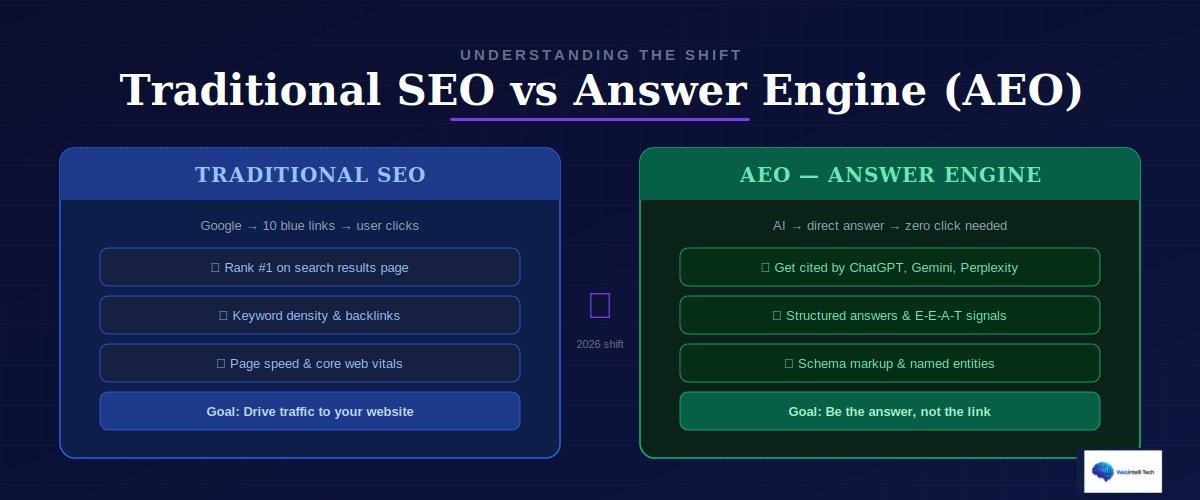
At its heart, SEO and AEO are built on completely different assumptions about how people find information.
SEO was designed for a world where search means “give me a list of relevant pages and I’ll pick one.” The game was always about visibility – get onto page one, preferably position one, and users will come to you. Every SEO tactic – keyword research, meta tags, backlinks, page speed – traces back to this single goal: earn the click.
AEO is designed for a world where search means “just tell me the answer.” When someone asks ChatGPT, “What is the best CRM for a 10-person startup?”, they don’t want ten links. They want a recommendation with reasoning. When they ask Perplexity, “How does compound interest work?”, they want a clear explanation, not a trip to Investopedia.
In an answer engine world, the click may never happen. Your content either becomes the source of the answer, or it doesn’t exist in the AI’s world at all.
A Brief History: How We Got Here
To understand why AEO exists, you need to understand how search evolved.
2000–2012: The link era. Google’s PageRank algorithm treated backlinks as votes of authority. SEO became a game of accumulating links, often through manipulative schemes – link farms, paid links, article spinning.
2012–2018: The content era. Google’s Panda and Penguin updates killed spammy link building. The industry pivoted to “content is king.” Long-form blogs, pillar pages, and topical authority became the dominant strategy. The 10 blue links were still there, but the competition for them intensified enormously.
2019–2022: The featured snippet era. Google started answering questions directly at the top of the results – position zero. Smart marketers learned to structure content in FAQ format, use schema markup, and win these boxes. This was the early whisper of what AEO would become.
2023–2026: The AI answer era. ChatGPT crossed 100 million users in record time. Google launched AI Overviews (formerly SGE). Perplexity emerged as a genuine Google alternative. Microsoft integrated AI into Bing. Now, for a growing percentage of queries, the search result is the answer – and the source being cited may or may not be you.
AEO is not a prediction about the future. It is a response to the present.
The 7 Key Differences: SEO vs AEO
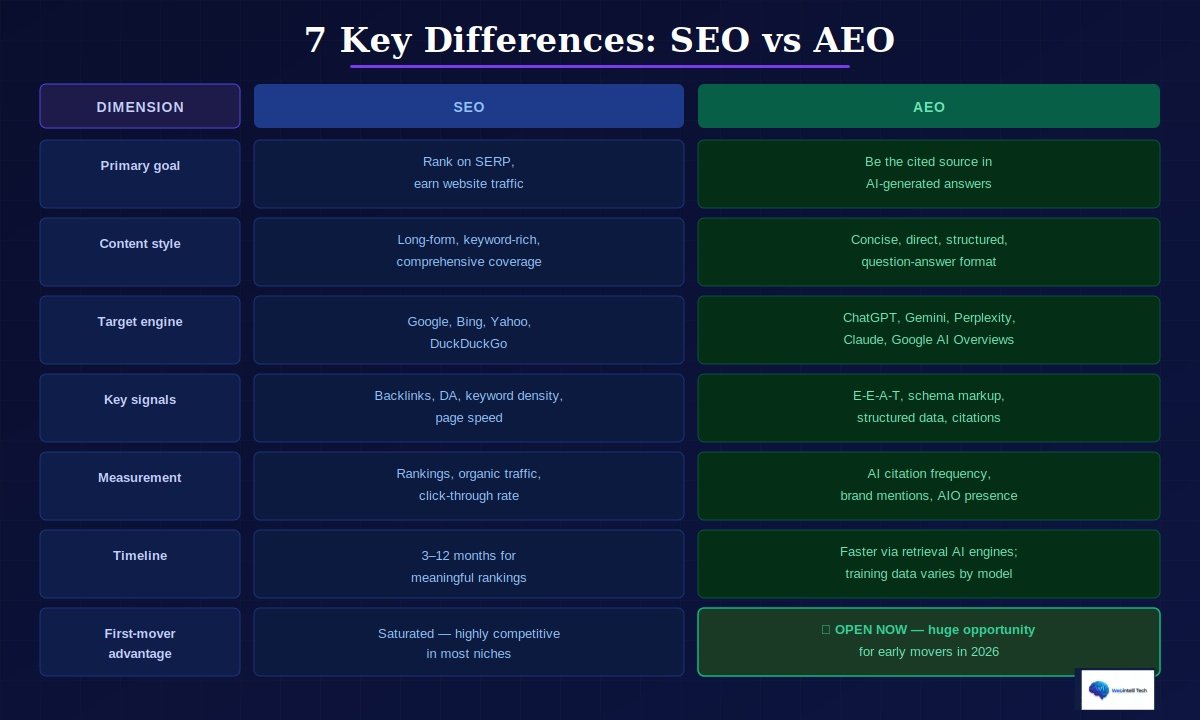
Let’s walk through each of these differences in depth:
Difference 1: The Goal
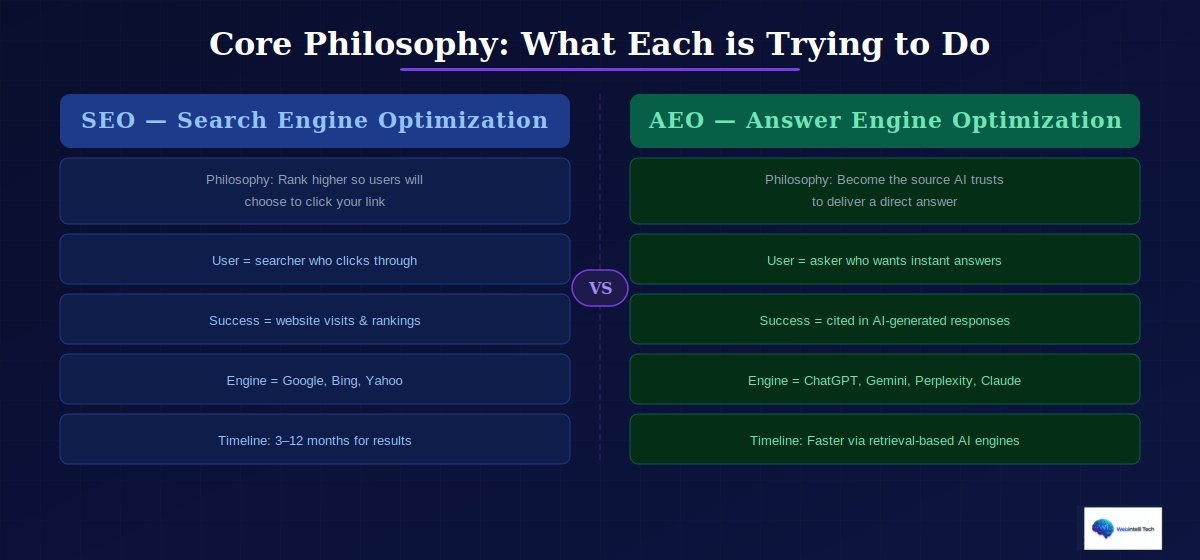
SEO’s goal is a click. You want a user to see your page title and meta description in Google’s results and choose to visit your website. Every SEO optimization ultimately serves this: get seen, get clicked, get the visit.
AEO’s goal is a citation. You want an AI to read your content, understand it as authoritative, and include it as part of a synthesized answer. The user may never click your link. But if your brand and expertise are part of the answer they receive, you’ve still won mindshare, authority, and often, intent-rich referral traffic when they do click.
The mindset shift is significant. In SEO, you are competing to be seen. In AEO, you are competing to be trusted.
Difference 2: Content Style
SEO rewards comprehensiveness. The prevailing wisdom for years has been to create the “ultimate guide” – a 4,000-word masterpiece covering every angle of a topic. Word count signals effort and authority. Internal linking keeps users engaged. Multimedia adds dwell time.
AEO rewards clarity. AI systems don’t need to be impressed by volume. They need to extract a clean, accurate, citable answer. This means:
- Questions should appear explicitly in your headings
- Answers should follow immediately, in the first 1–3 sentences after each heading
- Content should be structured with FAQs, numbered steps, and definition blocks
- Technical jargon should be explained, not assumed
A 5,000-word blog written for SEO might contain the answer an AI needs – buried in paragraph eight. AEO-optimized content surfaces that answer immediately, making it easy for the model to extract and attribute.
Difference 3: The Engine You’re Optimizing For
This is the most obvious difference and the one most marketers grasp immediately.
SEO targets: Google (91% market share), Bing, DuckDuckGo, Yahoo
AEO targets: ChatGPT, Google Gemini, Perplexity AI, Claude (Anthropic), Microsoft Copilot, Google AI Overviews, Meta AI
Each of these AI systems indexes, trains on, or retrieves information differently. Some (like Perplexity) do real-time web retrieval. Others (like ChatGPT’s base model) rely on training data with a knowledge cutoff. Google AI Overviews blend real-time retrieval with Google’s index.
Optimizing for all of these requires content that is broadly trustworthy, clearly structured, and correctly attributed – which is why AEO tactics tend to work across AI platforms, not just one.
Difference 4: Key Ranking Signals
For SEO, the dominant signals remain domain authority, backlink profile, core web vitals (page speed, layout stability), keyword placement, and internal link structure. These are well-understood, measurable, and the subject of an entire industry of tools.
For AEO, the signals are less codified but increasingly understood:
E-E-A-T (Experience, Expertise, Authoritativeness, Trustworthiness): Google’s own quality guidelines, now heavily influencing how AI systems evaluate content. Named authors with credentials, cited sources, and demonstrable expertise all signal trustworthiness.
Schema markup: Structured data (FAQ schema, HowTo schema, Article schema) helps AI systems parse and categorize your content correctly.
Named entities: Proper nouns – people, places, organizations, products – help AI systems place your content in a knowledge graph and understand what topics you authoritatively cover.
Citation patterns: AI models learn from the web. Content that is widely cited, quoted, or linked to by other authoritative sources gets weighted as more reliable.
Difference 5: Measurement
One of the genuine challenges of AEO is measurement – the metrics are less mature than SEO’s well-established dashboard of rankings, traffic, and conversions.
For SEO, you track: keyword rankings (Ahrefs, SEMrush), organic traffic (Google Analytics, Search Console), click-through rate, time on page, and bounce rate.
For AEO, you track: AI citation frequency (tools like Profound, BrandMentions, or manual prompting audits), presence in Google AI Overviews (Search Console is adding this), direct brand search volume (a proxy for AI-driven awareness), and referral traffic from AI platforms (Perplexity, for example, sends referral traffic tagged distinctly in GA4).
AEO measurement is still evolving – which actually makes it a first-mover opportunity. Brands building AEO measurement frameworks now will have a significant advantage as these metrics mature.
Difference 6: Timeline
SEO is famously slow. A new domain targeting competitive keywords can take 6–18 months to gain meaningful traction. Even established sites can wait 3–6 months to see ranking improvements after a content update.
AEO timelines are different and, in some ways, more immediate. When Perplexity crawls your content today, it may reference it in an answer tomorrow. When you add schema markup, Google’s crawlers can pick it up within days. That said, getting into an AI model’s training data (rather than its retrieval layer) takes longer and depends on the model’s retraining schedule.
The practical implication: AEO can produce faster citation wins, especially through retrieval-based AI engines, while SEO remains the long-game foundation.
Difference 7: First-Mover Advantage
SEO: The first-mover window largely closed years ago in most niches. Competitive keywords are dominated by established domains with years of authority, thousands of backlinks, and massive content libraries. Breaking into the top 3 results for high-volume keywords requires significant time, budget, and patience. For most businesses, SEO is a maintenance and incremental-gain game, not a land-grab.
AEO: The window is wide open right now in 2026. Most businesses — including your direct competitors — have not yet structured their content for AI citation. Most have not added FAQ schema. Most do not monitor their AI presence. Most have not thought about what questions AI systems are being asked in their niche.
This is a rare window. In the early days of SEO (circa 2005–2010), brands that published well-structured, authoritative content consistently became the dominant voices in their niches for the next decade. We are in that same early window for AEO — right now.
The brands that take AEO seriously in 2025–2026 will build AI authority that compounds over time, just as early SEO movers built domain authority that has proven nearly impossible for late entrants to overcome.
The question isn’t whether AEO matters. The question is whether you’ll act before your competitors do.
Do You Need Both SEO and AEO?
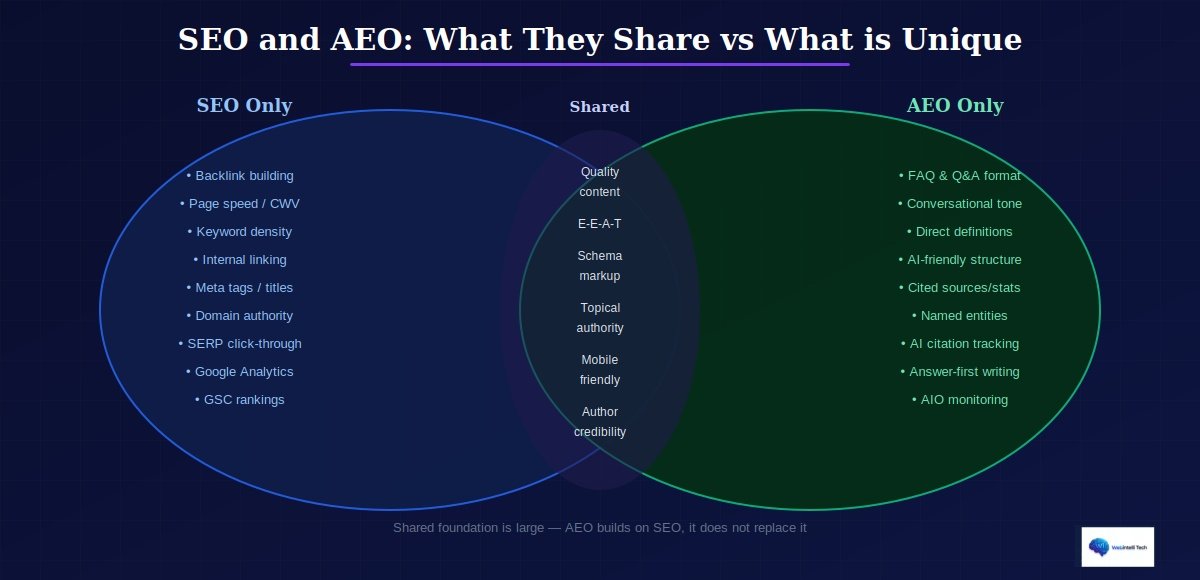
Yes – and this is the most important strategic insight in this entire article.
AEO is not a replacement for SEO. It is an evolution and an extension. The Venn diagram above shows why: the overlap between SEO best practices and AEO best practices is substantial. High-quality, authoritative, well-structured content is the foundation of both. E-E-A-T matters to both Google’s algorithm and AI citation engines. Schema markup helps both traditional search and AI parsing.
The practical implication: you don’t throw away your SEO strategy to pursue AEO. You augment it.
Where SEO asks “what keywords does this content rank for?”, AEO asks “what questions does this content definitively answer?”
Where SEO asks “how many backlinks does this page have?”, AEO asks “would an AI trust this source to represent the authoritative view on this topic?”
Where SEO asks “is this page fast and mobile-friendly?”, AEO asks “can an AI extract a clean, complete, citable answer from this page within the first three sentences of any section?”
Brands winning in 2026 are doing both – maintaining their SEO foundations while restructuring their content architecture to be answer-friendly.
A Real-World Example: The Same Query, Two Strategies
Let’s make this concrete. Suppose you run a personal finance blog and you want to rank for the query: “What is dollar cost averaging?”
The SEO approach produces a 2,500-word pillar page covering: the definition, historical background, how it works mechanically, mathematical examples, pros and cons, comparison to lump-sum investing, suitable investor profiles, tax implications, and an FAQ.
The keyword “dollar cost averaging” appears in the H1, several H2s, the meta description, and throughout the body. You build internal links from related posts and pursue backlinks from finance publications.
The AEO approach does everything above – and adds: a crisp, self-contained definition in the first paragraph that could stand alone as a quoted snippet
(“Dollar cost averaging is an investment strategy where you invest a fixed amount of money at regular intervals, regardless of market price, reducing the impact of volatility over time.”); an explicit FAQ section with questions phrased exactly as users would ask them (“Is dollar cost averaging better than lump sum investing?”);
FAQ schema markup in the page’s JSON-LD; the author’s byline with credentials; and citations to data from reputable financial research organizations.
The SEO version aims to get you to position one on Google. The AEO version ensures that when someone asks ChatGPT or Perplexity, “What is dollar cost averaging?”, your definition and your brand are what get cited.
The Zero-Click Problem and Why AEO is the Answer
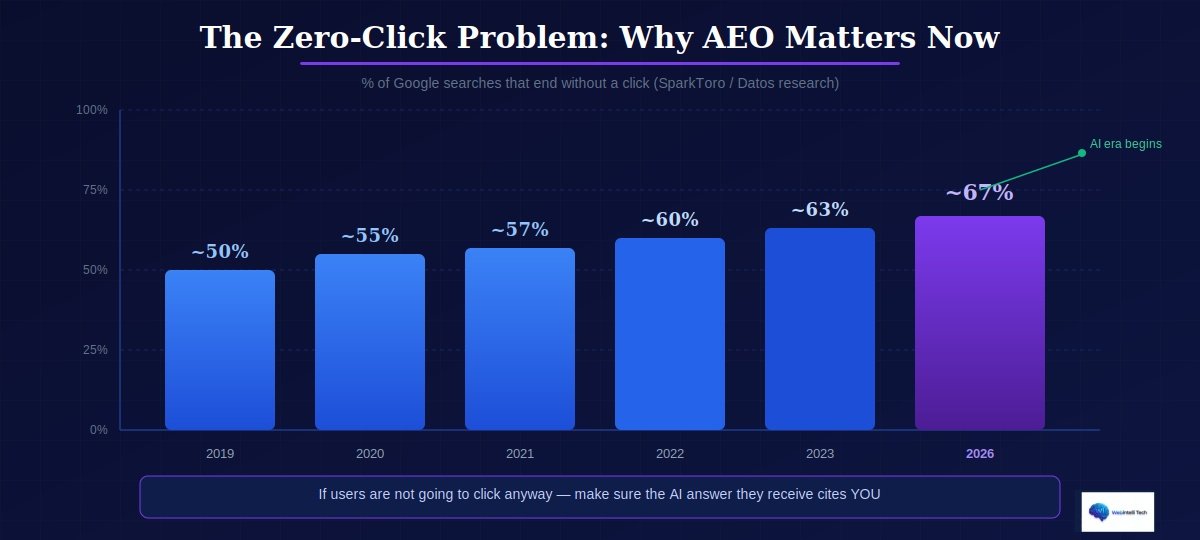
The zero-click problem is the clearest argument for why every SEO practitioner needs to understand AEO.
Research from SparkToro and Datos has consistently shown that more than half of all Google searches now end without a click. Users get what they need – a quick fact, a definition, a time, a conversion, a sports score – directly on the results page. This was already a challenge in the featured-snippet era. With AI Overviews now appearing on a large percentage of informational queries, the number of zero-click searches is growing further.
Here’s the strategic pivot that AEO enables: if users aren’t going to click anyway, make sure the answer they get cites you.
A zero-click search where your brand appears in the AI-generated answer is infinitely better than a zero-click search where your competitor’s brand appears. You still receive brand exposure, authority signals, and frequently, the searcher will follow up with a branded query (“tell me more about [your brand]’s approach”) – which converts at dramatically higher rates.
How AEO Builds On (Not Against) SEO
Here’s a framework many practitioners find useful: think of SEO as building the highway and AEO as ensuring your signs are clear enough for both human drivers and AI navigation systems to read.
Technical SEO → Technical AEO Page speed, mobile-friendliness, and crawlability that you’ve invested in for SEO directly benefit AEO. Fast, accessible pages are also AI-friendly pages. The investment carries over.
Topical authority → AI trust signals The SEO practice of building topical authority through content clusters is also one of the most powerful AEO tactics. When an AI system sees that your domain has comprehensive, consistently accurate coverage of a topic, it’s more likely to cite you as an authoritative source.
Keyword research → Question research SEO keyword research tells you what people search for. AEO question research tells you exactly how people phrase their questions to AI assistants. These are often different. “Best CRM software” is an SEO keyword. “What CRM should a 10-person B2B startup use in 2026?” is an AEO question. Both deserve content.
On-page optimization → Answer architecture Just as SEO taught us to put keywords in H1 tags and meta descriptions, AEO teaches us to put answers in the first paragraph after a question-format heading. The principle is the same – make the most important signal easy to find – the execution is slightly different.
Ready to Go Deeper? Get the Complete AEO Playbook
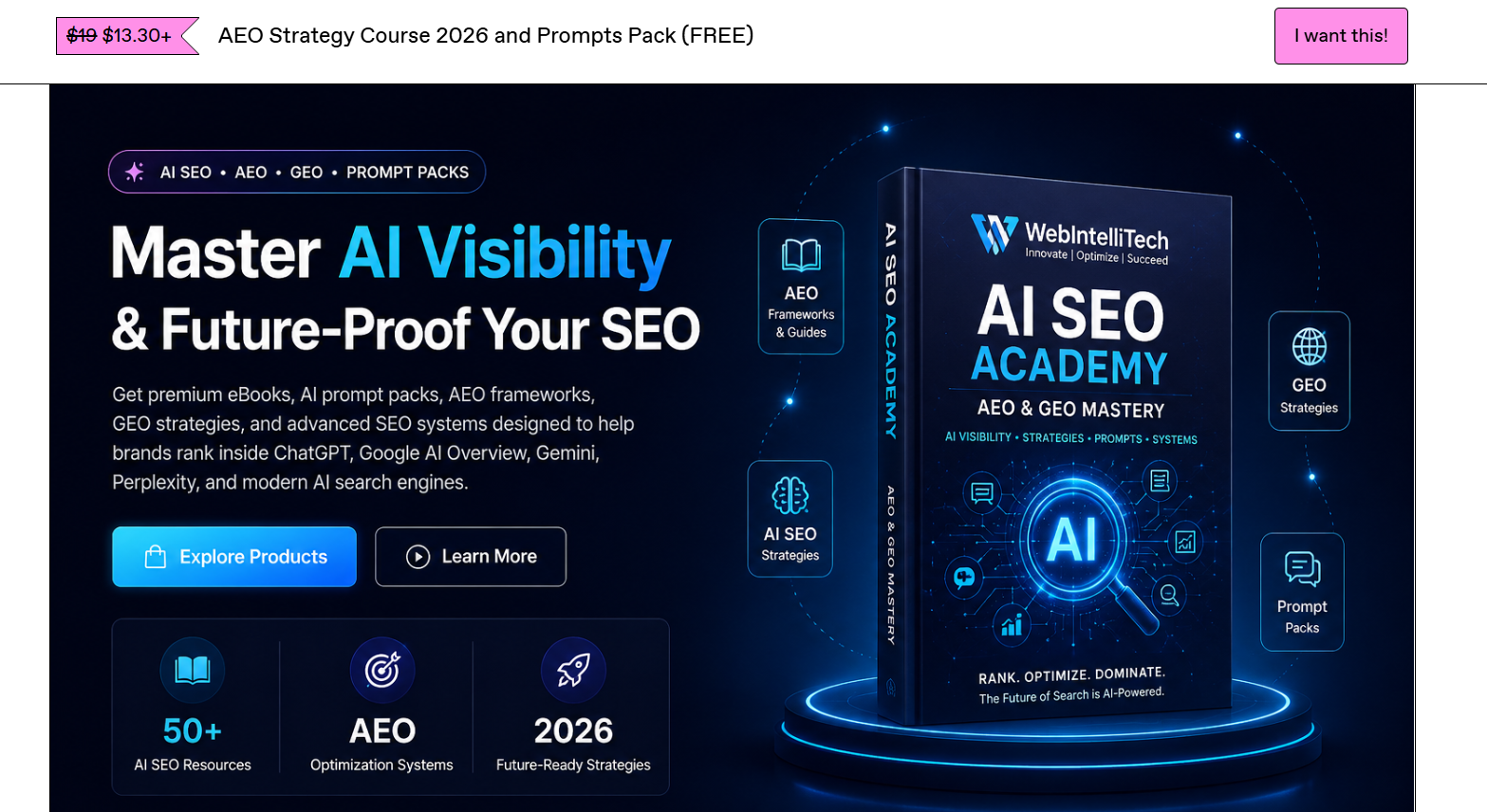
If this article has given you the conceptual framework, the next step is implementation – and that’s exactly what the AEO Mastery Course & E-Book covers in full.
Get the AEO Mastery E-Book on Gumroad →
Inside you’ll find: the complete AEO audit checklist, content templates optimized for AI citation, schema markup code you can copy-paste, the 30-day AEO implementation roadmap, and real case studies of brands winning in AI search. Whether you’re an SEO professional adding AEO to your toolkit or a business owner building authority from scratch, this is the most practical AEO resource available in 2026.
Common Misconceptions About SEO vs AEO
“AEO will kill SEO.” No. They are complementary. Google still drives billions of searches per day, and traditional SERP rankings still matter enormously. AEO is an addition to your strategy, not a replacement.
“If I rank #1 on Google, AI will automatically cite me.” Not necessarily. AI systems don’t simply pull from the #1 ranking page. They evaluate trustworthiness, content structure, clarity, and citation patterns. A #4 page with excellent FAQ schema and clear expert attribution may be cited over a #1 page that buries its answers in dense paragraphs.
“AEO is only for big brands.” False. AEO actually levels the playing field. A niche expert with deep, well-structured content on a specific topic can outperform a large brand with thin, AI-unfriendly content. The criteria are structural and qualitative, not purely about domain authority.
“I need to start over with my content for AEO.” Rarely. In most cases, AEO optimization means retrofitting existing strong content: adding FAQ sections, restructuring introductions to lead with answers, adding schema markup, and ensuring author bios are visible and credible. It’s evolution, not demolition.
A Quick Self-Assessment: Where Are You on the SEO-to-AEO Spectrum?
Ask yourself these questions to find your position on the spectrum:
- Do your blog posts open with a direct, quotable answer to the question in the title? (AEO basic)
- Do you use FAQ schema markup on your how-to and question-answer pages? (AEO foundational)
- Do your authors have visible bio pages with credentials and social proof? (E-E-A-T)
- Do you track whether your content appears in Google AI Overviews? (AEO measurement)
- Have you audited which of your competitors’ pages are being cited by ChatGPT or Perplexity? (AEO competitive intelligence)
- Is your content written to answer questions in the exact phrasing a user might type into an AI assistant? (AEO content architecture)
If you answered “no” to most of these, you’re at Stage 1. That’s fine – but it means there is a significant, accessible opportunity ahead of you.
The 2026 Action Plan: Bridging SEO and AEO
Based on everything above, here’s a practical sequence for integrating AEO into an existing SEO strategy:
Month 1 – Audit and prioritize. Identify your top 20 SEO-performing pages. For each, ask: Does it directly and concisely answer the main question? Add FAQ sections and ensure the opening paragraph leads with the answer.
Month 2 – Schema and structure. Implement the FAQ schema, the HowTo schema, and the Article schema across your priority content. Ensure author bios are visible and linked to credential pages.
Month 3 – E-E-A-T strengthening. Add expert quotes, cite external research, and ensure every claim can be attributed. Update author bylines with specific credentials.
Month 4 – AI citation monitoring. Set up a regular cadence of testing your brand and target queries in ChatGPT, Perplexity, and Google AI Overviews. Note who is being cited for the questions you should own, and reverse-engineer their content structure.
Month 5–6 – New content creation. Use question research to identify queries that your existing content doesn’t cover, but that show high AI search volume. Build answer-optimized content for these gaps.
Final Thoughts: SEO and AEO Are Two Sides of the Same Coin
The question isn’t really “SEO or AEO?” – it’s “are you optimizing for every way your audience finds information?”
In 2026, some of your potential customers will type a query into Google and click a blue link. Some will ask Perplexity a question and trust the AI’s synthesized answer. Some will have a conversation with ChatGPT that references your brand – or doesn’t. Some will see your content in a Google AI Overview and decide you’re the expert they want to hire.
Each of these touchpoints is a revenue opportunity. SEO captures the first. AEO captures the rest.
The brands, consultants, and content creators who understand both – and who build content that performs across both traditional search and AI answer engines – are the ones who will dominate the next decade of digital visibility.
Don’t wait for AEO to become mainstream to start. The first-mover window is open right now.
Want the Full AEO Playbook?
Everything in this blog is the what and why. The AEO Mastery E-Book is the how – with templates, checklists, code snippets, and a 30-day implementation plan.
Download the AEO Mastery E-Book on Gumroad →
Join hundreds of marketers, content creators, and SEO professionals who are already building their AI-search presence before the competition catches up.
Part of the AEO Pillar Cluster series. Read Blog #1: What is AEO? Complete Answer Engine Optimization Guide for 2026 for the full foundational overview.