
The Way People Search Has Changed Forever
Think about the last time you typed something into Google and actually clicked on a result.
For a lot of people, that’s happening less and less.
More and more, we type a question, and the answer… appears. Right there on the page. No clicking. No reading through five blog posts—just an answer.
That is not a coincidence. That is the result of a massive shift happening in how search engines work — and it is changing the rules for every business that relies on the internet to find customers.
This shift has a name: Answer Engine Optimisation (AEO).
If you have been doing SEO for your business (or paying someone to do it), this guide is important for you to read. Not because SEO is dead — it is not —, but because the game has a new layer, and if you are not playing it, your competitors will be.
Let us break it all down, properly, from scratch.
What is AEO (Answer Engine Optimisation)?
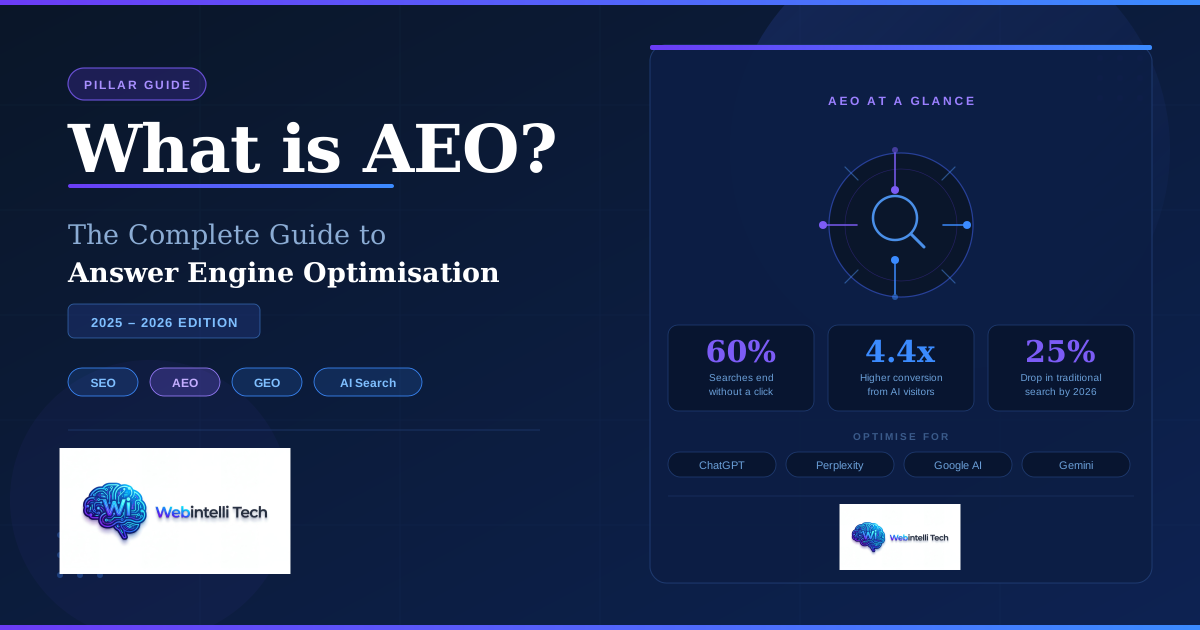
AEO stands for Answer Engine Optimisation. It is the process of optimising your content so that AI-powered search engines and tools — like Google’s AI Overviews, ChatGPT, Perplexity, Gemini, and Bing Copilot — pull your content as the direct answer to a user’s question.
Traditional SEO was about ranking on Page 1 of Google. You wanted the top spot, so users would see your link and click it.
AEO is different. The goal here is not just to rank — it is to be the answer. To have an AI engine read your content, trust it, and serve it directly to the person asking — often without them ever visiting your website.
Here is a simple way to think about it:
SEO = Get people to find your link. AEO = Get AI to use your content as the answer.
Both matter. But in 2026, AEO is becoming the more urgent of the two.
Why Does AEO Matter So Much Right Now?
Let us talk numbers for a moment, because these are hard to ignore.
Nearly 60% of Google searches now end without a single click. The user typed, read the AI-generated answer at the top, and moved on. Your website never entered the picture.
ChatGPT now has over 400 million weekly active users. Perplexity processes millions of queries every day. Google’s AI Overviews reach close to a billion searchers. These are not small experiments. This is where search is going.
Gartner predicted that traditional search engine volume would drop by 25% by 2026 due to AI chatbots taking over. That prediction is playing out right now.
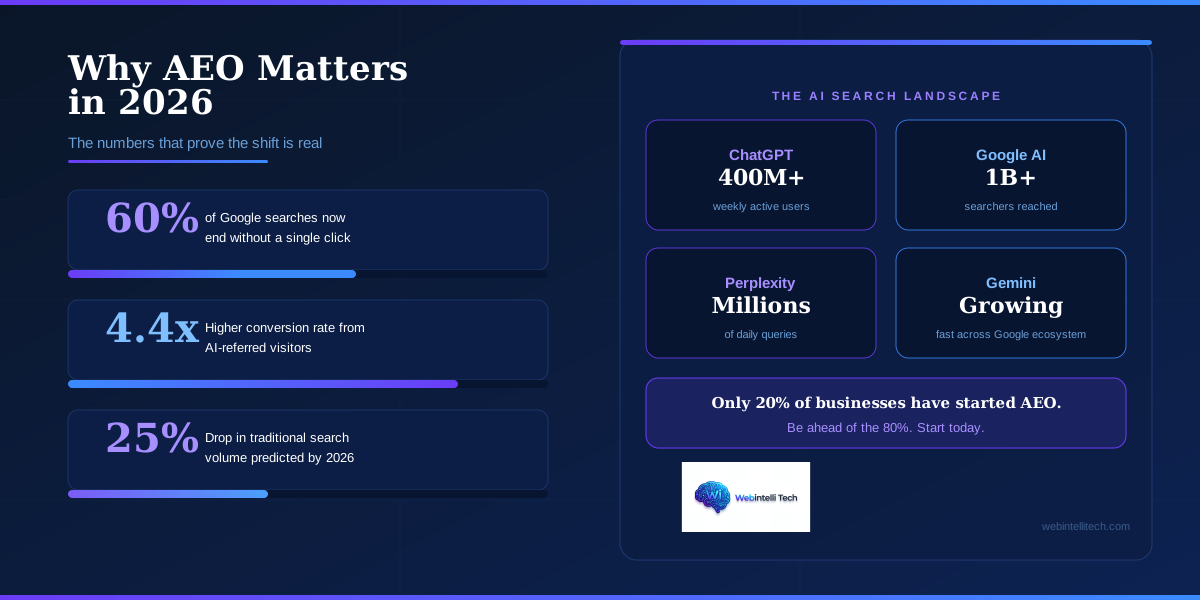
And here is something that should really grab your attention: AI-driven visitors convert at 4.4 times the rate of standard organic visitors, and they spend 68% more time on your site. Why? Because by the time an AI cites you, the user already trusts the answer. They arrive pre-qualified, curious, and ready.
So the stakes are real. If AI engines do not know about you, do not trust your content, or cannot extract clear answers from your pages — you are invisible to a massive and fast-growing segment of searchers.
AEO vs SEO: What’s the Actual Difference?
This is probably the most common question people ask, so let us settle it clearly.
SEO (Search Engine Optimisation) is about getting your pages to rank well on search engines like Google, based on signals like keywords, backlinks, page speed, and authority.
AEO (Answer Engine Optimisation) goes a step further. It is about structuring and presenting your content so that AI systems can extract, understand, and cite it as a direct answer to a user’s question.
| Traditional SEO | AEO | |
|---|---|---|
| Goal | Rank high in search results | Be cited as the answer in AI responses |
| Format | Keyword-optimised pages | Q&A format, clear definitions, structured data |
| User Action | User clicks your link | AI reads and presents your content |
| Search Engines | Google, Bing | ChatGPT, Perplexity, Google AI Overviews, Gemini |
| Success Metric | Rankings, organic traffic | AI citations, featured snippet wins, brand mentions in AI answers |
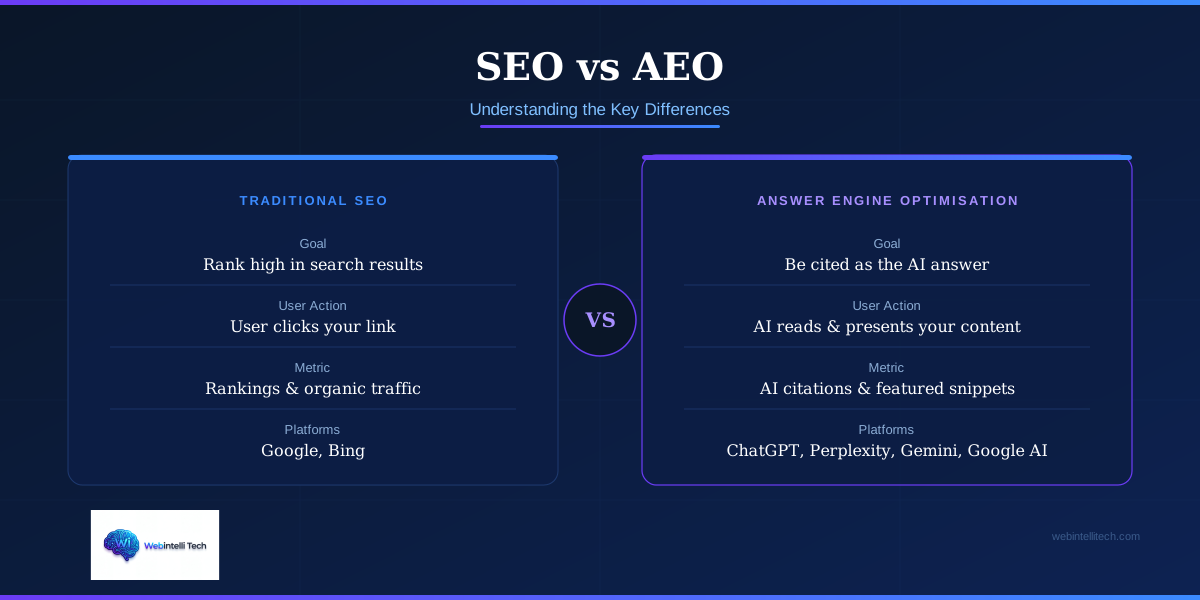
The important thing to understand: AEO (Answer Engine Optimisation) does not replace SEO. It builds on top of it. If your site has technical problems, slow loading, or weak authority, AI engines will not trust or cite your content either. You need both.
How Do Answer Engines Actually Work?
To optimise for something, you need to understand how it works.
When someone asks ChatGPT, “What is the best SEO strategy for a small business?”, ChatGPT does not randomly generate an answer. It pulls from content it has been trained on, and — increasingly — from live web searches. It evaluates sources, looks for clear and authoritative answers, and packages the most trustworthy information into a response.
Google’s AI Overviews work similarly. When you search on Google and see that blue AI-generated summary at the very top, Google has scanned multiple pages, extracted the most relevant and trustworthy content, and assembled it into a direct answer.
What this means for your content:
- Clarity wins. If your content takes three paragraphs to get to the point, AI will skip to someone who answered in two sentences.
- Structure matters. Headings, bullet points, numbered lists, and FAQ sections make it easier for AI to extract specific answers.
- Trust signals count. AI engines look at E-E-A-T (Experience, Expertise, Authoritativeness, Trustworthiness). If your site looks credible, your content is more likely to be cited.
- Schema markup helps. Adding structured data to your pages is like giving AI a cheat sheet — it signals exactly what type of content you have and what questions it answers.
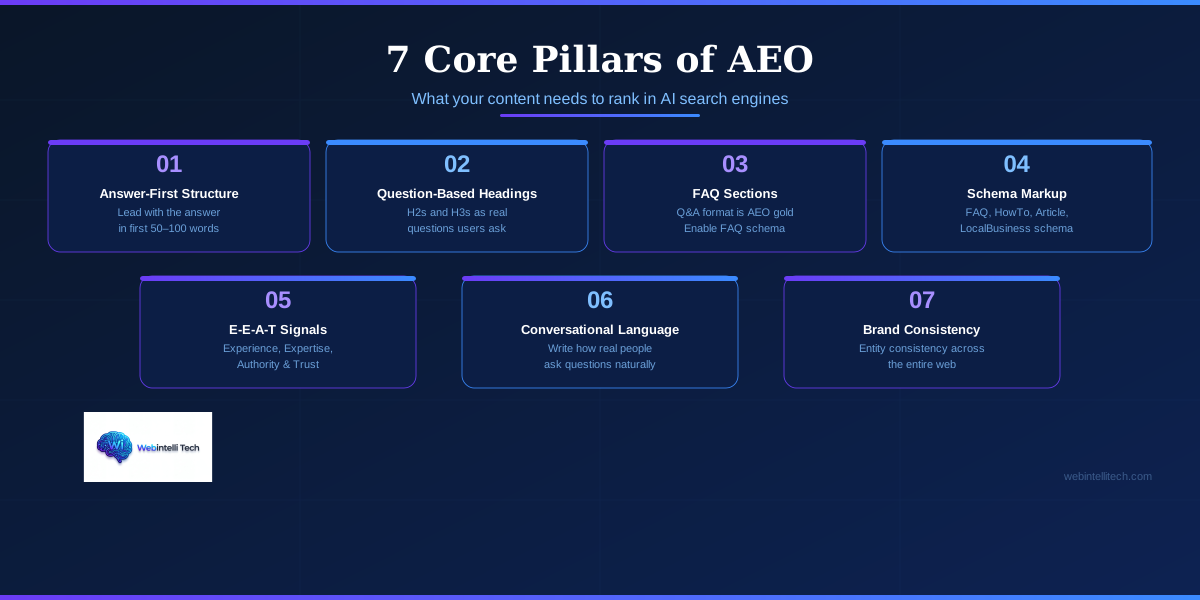
The 7 Core Pillars of AEO (Answer Engine Optimisation)
Here is where we get practical. If you want to start optimising for answer engines, these are the seven areas you need to focus on.
1. Answer-First Content Structure
Stop burying the answer. In traditional long-form writing, you build up to the point. In AEO, you lead with it.
Every piece of content should answer the core question within the first 50–100 words. Then you can elaborate, add context, and go deeper. But the quick, clear answer needs to come first.
Think of it like a newspaper headline — the most important thing up front, details later.
2. Question-Based Headings (H2s and H3s)
AI engines scan your headings to understand what question each section answers. If your H2 is “Our Approach to Marketing,” that tells an AI engine almost nothing. If your H2 is “How Does Digital Marketing Help Small Businesses?”, that is a question — and AI engines love questions with clear answers.
Go through your key pages and blog posts. Rewrite headings as natural questions your customers actually ask.
3. FAQ Sections on Every Key Page
FAQ sections are one of the most powerful AEO tools you have. When you add a proper FAQ section at the end of a blog post or service page — with real questions and direct answers — you are essentially creating a library of citable responses.
Enable Rank Math’s FAQ schema on every page that has an FAQ section. This tells search engines (and AI systems) that your content is structured as a Q&A, making it far more likely to be pulled as a direct answer.
4. Schema Markup (Structured Data)
Schema markup is code added to your pages that helps search engines understand your content. For AEO (Answer Engine Optimisation), the most important schema types are:
- FAQ Schema — For question-and-answer sections
- HowTo Schema — For step-by-step guides
- Article Schema — For blog posts and editorial content
- LocalBusiness Schema — For location-based businesses
- Product Schema — For e-commerce or service listings
Rank Math makes this easy — you can enable most of these without touching code. Just make sure you are actually using them on relevant pages.
5. E-E-A-T Signals (Experience, Expertise, Authoritativeness, Trust)
AI engines, just like Google’s quality raters, assess whether your content comes from a source that actually knows what it is talking about.
What builds E-E-A-T?
- A proper author bio with credentials
- Mentioning real-world experience (case studies, client results, specific examples)
- Citations and references to credible sources
- Consistent NAP information (Name, Address, Phone) across the web for local businesses
- Reviews and testimonials that show real clients trust you
- Regular content updates (stale content gets deprioritised)
This is not a quick fix. E-E-A-T is built over time. But every piece of content you publish is an opportunity to add to it.
6. Conversational and Natural Language
People do not type “best AEO agency India” into ChatGPT. They ask “What is the best AEO agency in India for my small business?”
AI engines process natural, conversational language. Your content needs to reflect how real people actually talk and ask questions — not just the short-tail keywords that dominated old-school SEO.
This does not mean abandoning keywords. It means expanding around them. Use full questions. Use the way your customers describe their problems. Write the way a knowledgeable friend would explain something.
7. Brand Consistency Across the Web
AI systems do not just read your website. They gather information from across the entire web — review platforms, social media, directories, news articles, forums, and more. If your brand information is inconsistent across these sources, AI engines struggle to form a clear, confident picture of who you are.
Make sure your business name, description, services, location, and contact details are consistent everywhere your brand appears online. This is called “entity consistency,” and it is one of the most underrated AEO strategies.
What Content Works Best for AEO(Answer Engine Optimisation) ?
Not all content is equally AEO-friendly. Here are the content formats that AI engines love to cite:
Definitions and explanations — “What is X?” pages that answer clearly and quickly.
Comparison content — “X vs Y” posts that lay out differences in a structured way (like tables).
Step-by-step guides — How-to content with numbered steps is highly citable.
Statistics and data — AI engines love to pull specific numbers. If you publish original research or data, you become a citable source.
FAQ pages — As mentioned, these are AEO gold.
Checklists — Structured, scannable, actionable. Perfect for AI extraction.
What tends to perform poorly for AEO (Answer Engine Optimisation) : purely opinion-based pieces with no clear answers, vague content without specific information, and walls of text with no structure.
Common AEO Mistakes to Avoid
A lot of businesses try to “do AEO” without understanding what it actually requires. Here are the mistakes we see most often:
Treating AEO as a separate strategy from SEO. They are connected. If your site has technical issues — slow speed, broken links, no mobile optimisation — AI engines will not trust your content, regardless of how well-written it is.
Writing for AI instead of for humans. Your content still needs to be genuinely useful, clear, and well-written for real people. AI systems are getting very good at detecting thin or manipulative content.
Ignoring schema markup. Many businesses leave structured data completely untouched. This is a missed opportunity. Schema markup is one of the clearest signals you can send to AI engines about what your content answers.
Not updating old content. AI systems factor in freshness. A blog post last updated in 2022 is less likely to be cited than one updated in 2026 with current information.
Keyword stuffing in the old way. Repeating your focus keyword every 100 words does not work for AEO. What works is comprehensively answering a question — covering the topic from multiple angles the way an expert would.
AEO for Local Businesses: Does It Apply to You?
Absolutely. In fact, local businesses may have one of the biggest opportunities with AEO right now.
When someone asks Siri, Google Assistant, or ChatGPT, “Which digital marketing agency in Bhubaneswar does AEO (Answer Engine Optimisation) ?” — that is a local AEO query. The AI is looking for specific, trustworthy information about businesses in a location.
For local AEO (Answer Engine Optimisation), focus on:
- A fully optimised and regularly updated Google Business Profile
- Location-specific pages on your website that answer “who, what, and where” clearly
- Consistent citations across Indian business directories (JustDial, Sulekha, IndiaMART, etc.)
- Customer reviews that mention specific services and locations
- Schema markup that includes your LocalBusiness data
Local AEO (Answer Engine Optimisation) is still highly underutilised in India. For businesses in cities like Bhubaneswar, Bhopal, Jaipur, or Kochi — getting into AI answers for local queries right now, before it gets crowded, is a significant competitive advantage.
How to Measure AEO Success
One thing that confuses many people about AEO (Answer Engine Optimisation) is: how do you track it?
With traditional SEO, you track rankings and organic traffic. With AEO, the metrics look a little different:
- AI citation monitoring: Tools like Semrush, Ahrefs, and specialised platforms like Profound are now tracking where your brand appears in AI-generated answers.
- Featured snippet wins: In Google Search Console, check how many “Position 0” or featured snippet appearances your pages have.
- Brand mention tracking: Set up Google Alerts or Mention.com for your brand name. If you start appearing in AI answers, sometimes users share those responses, or it shows up in other tracking.
- Traffic from AI sources: In your analytics, look for traffic coming from ChatGPT, Perplexity, or referral sources tagged as AI tools. This is growing month by month.
- Conversion quality: AEO traffic tends to be higher intent. Track whether visitors from AI-driven sources convert better than your average organic visitor.
This space is evolving fast. New tools are emerging specifically for AI visibility measurement, and it is worth keeping an eye on them as they mature.
AEO in 2026: Where Things Are Heading
Search is not going backwards. AI Overviews are expanding. ChatGPT Search is growing. Perplexity is adding more users every month. Google’s AI Mode — a fully conversational search experience inside Google — is rolling out to more users.
Here is what matters for the near future:
Voice search and AEO are merging. Voice queries are almost always phrased as questions. If your content answers questions clearly, it is well-positioned for voice results.
Multimodal AI search is coming. AI systems are getting better at processing images and video alongside text. This means alt text, image descriptions, and video transcripts will become part of AEO best practice.
Agentic AI is the next frontier. AI agents will not just answer questions — they will book appointments, compare services, and make recommendations on behalf of users. Your content and business data need to be machine-readable and up to date.
The brands acting now will have a lasting advantage. Right now, around 70% of businesses understand that AEO will significantly impact their digital strategy within 1–3 years — but only about 20% have actually started. That gap is your opportunity.
How WebIntelliTech Can Help You With AEO
At WebIntelliTech, AEO is not an add-on — it is a core part of how we approach digital growth for our clients.
We help businesses:
- Audit their current visibility in AI search engines
- Restructure and rewrite content to be answer-engine ready
- Implement the right schema markup using Rank Math and other tools
- Build a content strategy aligned with how AI engines evaluate and cite sources
- Track AI citation performance and refine the strategy over time
We are based in Bhubaneswar and work with businesses across India and internationally. Whether you are starting from scratch or want to add AEO on top of an existing SEO strategy, we have a process that works.
👉 Get a Free AI Visibility Audit →
Frequently Asked Questions About AEO
Q: Is AEO (Answer Engine Optimisation) the same as SEO?
No. SEO focuses on ranking in traditional search results, so users click your link. AEO focuses on having your content cited or quoted directly by AI-powered answer engines like ChatGPT, Perplexity, and Google’s AI Overviews. Both matter, and a good digital strategy uses both together.
Q: Do I need to stop doing SEO and focus on AEO (Answer Engine Optimisation) instead?
Not at all. AEO builds on top of SEO. Strong technical SEO, good content, and solid backlinks all contribute to AEO success as well. Think of AEO as the next layer of your existing search strategy, not a replacement.
Q: How long does AEO (Answer Engine Optimisation) take to show results?
It depends on your starting point and competition, but most businesses start seeing improvement in featured snippets and AI citations within 3–6 months of consistent AEO work. Local businesses with specific niches can see results faster.
Q: Does AEO (Answer Engine Optimisation) work for small businesses?
Yes, absolutely. In fact, small businesses in specific niches or locations can often outperform larger brands in AI citations because they can create more targeted, specific, and authoritative content on focused topics.
Q: What tools do I need for AEO?
On WordPress, Rank Math is excellent for schema markup and on-page optimisation. Beyond that, tools like Semrush, Ahrefs, and Frase help with content optimisation. For tracking AI citations, platforms like Profound and Semrush’s new AI visibility features are worth exploring.
Q: Is AEO relevant for businesses in India?
Very much so. Indian businesses are already experiencing zero-click searches and AI Overviews in Google. The businesses that start optimising for AI search now — particularly in growing cities and niche industries — will have a significant early-mover advantage.
Q: Can AEO help my business get leads?
Yes. Studies show that visitors arriving from AI citations convert at significantly higher rates than standard organic visitors, because the AI has already answered their initial question and built trust. They arrive at your website further along in the decision-making process.
Final Thoughts
AEO is not a complicated concept. At its heart, it is simple: give AI engines clear, trustworthy, well-structured answers — and they will use your content when people ask questions.
What is new is the urgency. The window to establish yourself as a cited source in AI search is open right now, but it will get more competitive. Every month that passes, more businesses are waking up to this.
If you have been putting off understanding AEO, this is the sign to start. You do not need to throw out everything you have built with SEO. You need to build on top of it, with a few key changes in how you structure and present your content.
Start with one piece of content. Add an FAQ section. Rewrite your H2s as questions. Enable schema in Rank Math. Answer your core question in the first paragraph.
Those small steps, done consistently across your site, compound into real visibility in AI search.
And if you want help doing this the right way, we are here.
👉 Talk to the WebIntelliTech AEO Team →
Download the AEO Mastery E-Book on Gumroad.
Published by WebIntelliTech Solutions | Updated: May 2026 Category: AEO, Digital Marketing, AI Search Tags: answer engine optimisation, AEO, AEO vs SEO, AI search, ChatGPT SEO, Google AI Overviews, AEO strategy 2026