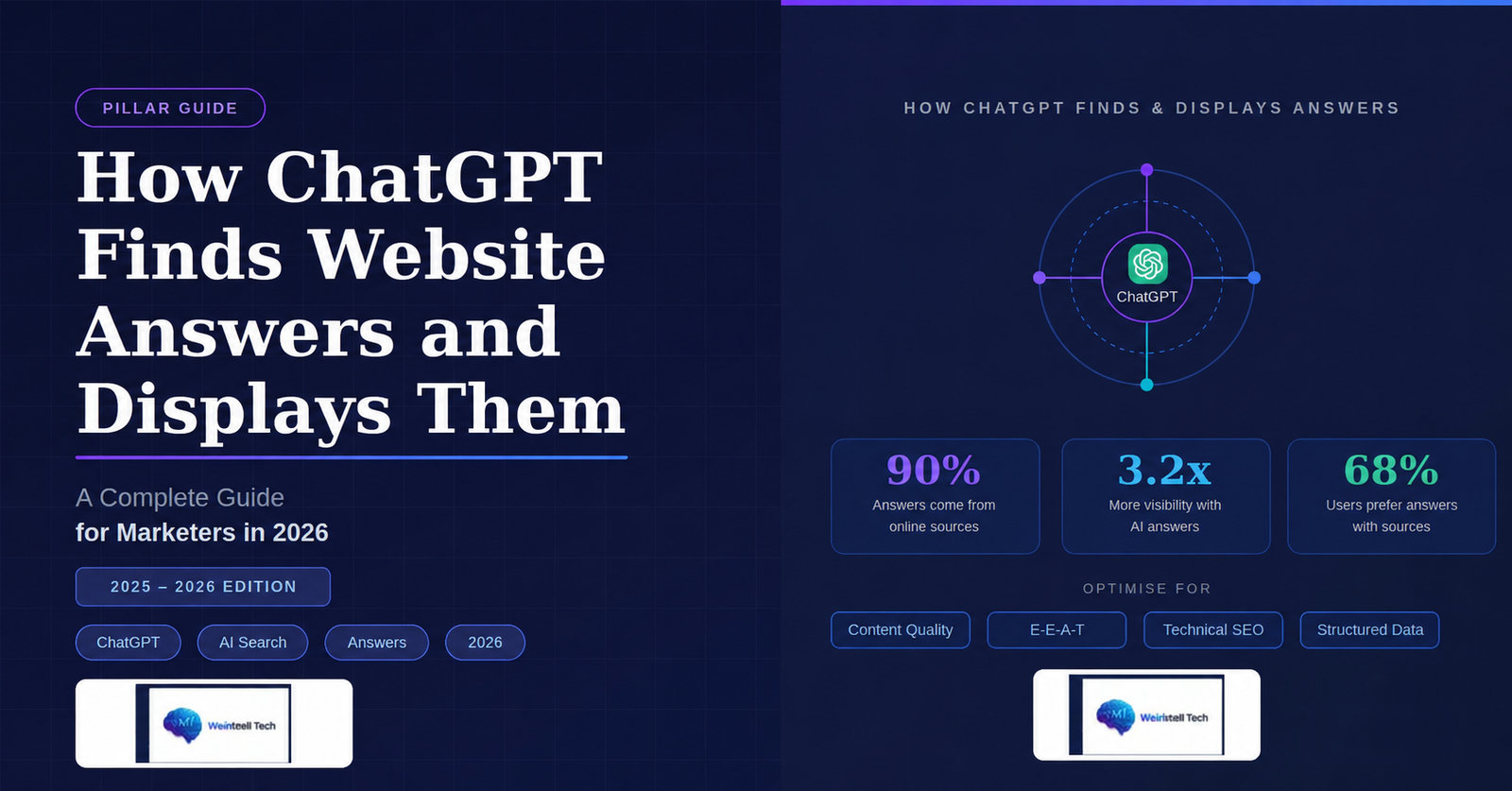
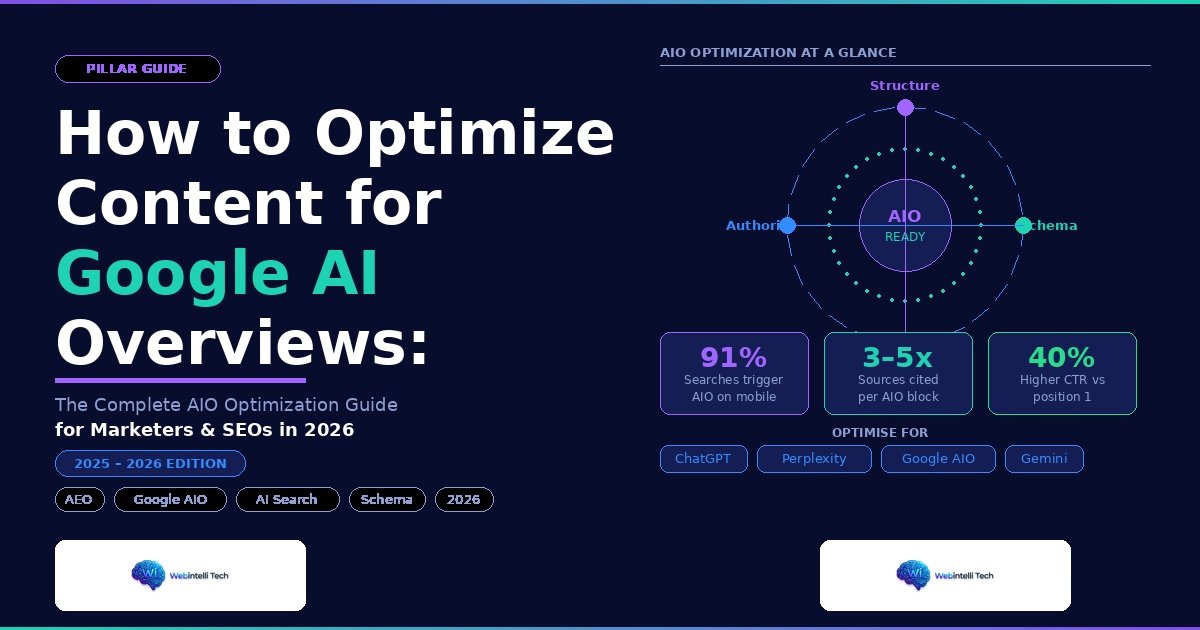
Let’s start to know how we can optimize Content for Google AI Overviews. You’ve noticed it. You search for something on Google, and before the traditional blue links, there’s a large AI-generated block that summarizes an answer — pulling from a handful of websites, citing them at the side. That’s Google AI Overviews (AIO), and it’s fundamentally reshaping how people find information online.
The question every content marketer and SEO is now asking: how do I get my website cited inside that AI Overview block?
The answer isn’t a single trick. It’s a systematic optimization strategy — built on clean content structure, semantic relevance, technical signals, and EEAT authority. This guide breaks it all down, step by step.
What’s in This Guide
- What is Google AI Overview, and how does it work?
- The 6 ranking signals Google uses to select AIO sources
- How to structure your content for AIO extraction
- Schema markup strategy for AI Overviews
- EEAT signals that build AIO authority
- Technical SEO checklist for AIO readiness
- 5 mistakes killing your AIO chances
- Quick-start action plan
1. What is Google AI Overview and How Does It Work?
Google AI Overview (previously called Search Generative Experience or SGE) is Google’s AI-generated answer block that appears at the very top of search results. Powered by Gemini, Google’s large language model, AI Overviews synthesize information from multiple web pages into a single, structured answer.
Unlike featured snippets — which pull one passage from one page — AI Overviews blend information from several sources, then cite those sources in a panel on the right side. This makes the citation mechanic fundamentally different from anything SEOs have optimized for before.
How does Google select AIO sources?
Google’s AIO system uses a two-layer process. First, it performs a traditional web search using its core ranking algorithm to identify the most relevant, authoritative pages for a query. Then, a secondary layer — the Gemini model — reads those top pages and determines which specific passages are most useful for composing the answer. The pages it draws from become the cited sources.
This means ranking well in traditional Google search is still the foundation — but it’s no longer sufficient. You also need your content to be extractable: clear, direct, and structured in a way that the AI can parse and repurpose confidently.
2. The 6 Ranking Signals Google Uses to Select AIO Sources
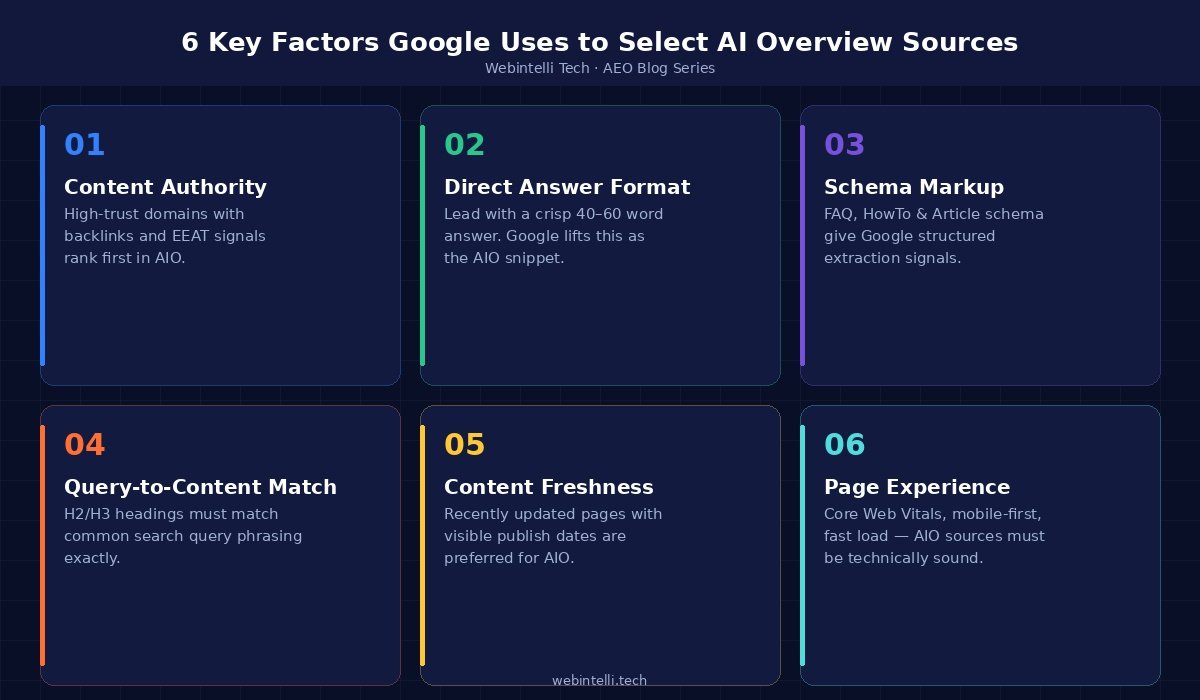
Based on extensive analysis of which pages appear in AI Overviews across thousands of queries, six signals consistently separate cited pages from uncited ones.
Signal 1 — Content Authority and EEAT
Google’s AI prioritizes content from sites that demonstrate Experience, Expertise, Authoritativeness, and Trustworthiness. High-authority domains with quality backlinks, clear author attribution, and cited references are significantly more likely to appear in AI Overviews. EEAT is the trust foundation — without it, even perfectly structured content won’t be selected.
Signal 2 — Direct Answer Proximity
Google’s extraction model looks for the direct answer to a query within the first 100–150 words of a section. Content that buries the answer in long preambles gets skipped. Leading every major section with a crisp, factual response — before any elaboration — is the single most impactful structural change you can make.
Signal 3 — Schema Markup and Structured Data
FAQ, HowTo, and Article schema tell Google’s systems exactly what type of content each section contains and who wrote it. Pages with proper schema markup are processed with far greater confidence by Gemini, making them preferred extraction candidates.
Signal 4 — Query-to-Content Semantic Match
Your H2 and H3 headings need to semantically match how users actually phrase their questions to Google. Not just keyword matching — but intent matching. A heading like “How does Google AI Overview decide what to show?” will attract more AIO citations for that query pattern than “Overview Selection Mechanisms.”
Signal 5 — Content Freshness
For queries where recency matters — marketing, tech, finance, health — Google’s AI heavily favors recently updated content. A visible “Last Updated” date, combined with genuinely refreshed information, signals to both the crawler and the Gemini model that your content is current.
Signal 6 — Page Experience Signals
Core Web Vitals, mobile responsiveness, and page load speed still matter. An AI Overview source needs to be a page that Google is confident will provide a good experience if a user clicks through to it. Pages with poor CWV scores or intrusive interstitials are deprioritized even if the content is strong.
3. How to Structure Your Content for AIO Extraction
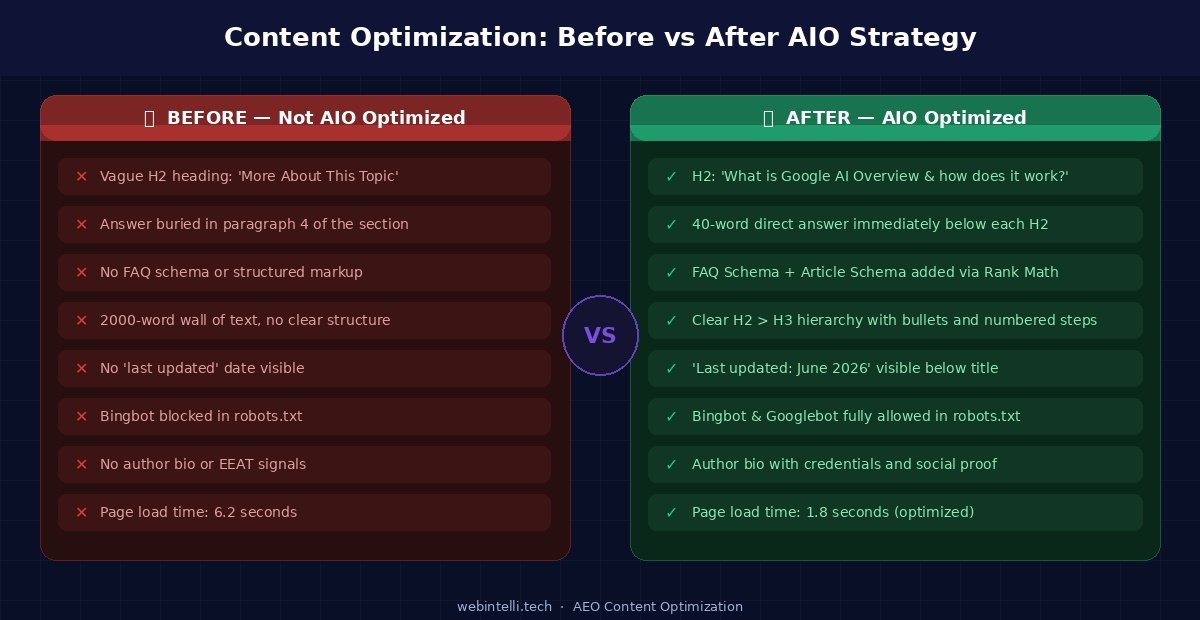
Content structure is where most sites fail the AIO test. They have great information, but it’s not organized in a way that Google’s AI can cleanly extract. Here’s the exact structure that maximizes AIO citation probability.
The “Answer First” principle
Every H2 section should begin with a direct, self-contained answer to the implied question of that heading. Think of it like an inverted pyramid: answer → explain → elaborate. Google’s AI reads the first paragraph of each section most heavily. If the answer is there, your section becomes extractable. If not, it gets passed over.
Use question-format headings
Convert your H2 and H3 headings from statement form to question form wherever it fits naturally. Instead of “Benefits of FAQ Schema,” use “What are the benefits of FAQ schema for SEO?” This directly mirrors how users query Google, which improves semantic alignment between your content and the triggering search intent.
-
Write a 40–60 word “lede” paragraph under each H2This is your extraction target. It must be complete — answering the question fully without requiring the reader to read further to understand the core point. Google lifts these paragraphs with high fidelity.
-
Use numbered lists for step-by-step contentHowTo-type queries (“how to set up FAQ schema”) trigger AI Overviews that prefer numbered steps. Structure tutorial content as ordered lists with a clear imperative action in each step heading.
-
Add a comparison table for vs. queries“X vs Y” queries often generate AI Overviews that use table formatting. If your content covers comparisons, include an HTML table with clear headers. This doubles as excellent structured data for Gemini to parse.
-
Add an explicit FAQ section at the bottomA dedicated FAQ section with 5–8 questions covering related long-tail queries serves double duty: it improves topic coverage for ranking, and with FAQ schema added, it becomes prime AIO source material for follow-up question patterns.
-
Include a conclusion summary paragraphEnd each major article with a “Key Takeaways” or summary section. This gives the Gemini model a clean, condensed version of the page’s core content — often the easiest section to extract for AI Overview synthesis.
4. Schema Markup Strategy for Google AI Overviews
Schema markup is the most underleveraged AIO optimization tactic. While every SEO knows about schema in theory, very few implement it consistently across their content. For AI Overviews, schema is not optional — it’s infrastructure.
FAQ Schema — your highest-impact AIO tool
FAQ schema wraps your question-and-answer content in machine-readable JSON-LD that Google’s systems can parse with zero ambiguity. When a user asks a question that matches one of your FAQ items, Gemini can pull that answer with high confidence — because the schema tells it exactly what the question is, what the answer is, and that it’s part of a curated FAQ rather than scattered body text.
{
“@context”: “https://schema.org”,
“@type”: “FAQPage”,
“mainEntity”: [{
“@type”: “Question”,
“name”: “How do I optimize content for Google AI Overviews?”,
“acceptedAnswer”: {
“@type”: “Answer”,
“text”: “Optimize content for Google AI Overviews by using direct answer paragraphs under each heading, adding FAQ and Article schema, building EEAT signals, and structuring content with question-format H2 headings that match real search queries.”
}
}]
}
Article Schema with Author markup
Article schema — combined with a Person schema for the author — tells Google who wrote the content, their credentials, and the publication context. This is a direct EEAT signal. For YMYL (Your Money Your Life) topics like finance, health, or legal, Article + Person schema is essentially mandatory for AIO consideration.
HowTo Schema for tutorial content
Any step-by-step guide or tutorial should have HowTo schema. It marks up each step individually with a name and description, making it trivially easy for Gemini to extract your steps into a numbered AI Overview response. Pages without HowTo schema compete against pages with it — and they lose.
Get the Full AEO Playbook — Schema Templates Included
The complete AEO e-book includes ready-to-copy FAQ schema templates, Article schema code, HowTo schema examples, and a 30-day AIO optimization action plan — built for WordPress sites.
Get the AEO E-Book on Gumroad →
5. EEAT Signals That Build AIO Authority
Google’s Search Quality Rater Guidelines define EEAT — Experience, Expertise, Authoritativeness, and Trustworthiness — as the framework for evaluating content quality. For AI Overviews, EEAT is a prerequisite, not a bonus. Gemini is trained to prefer sources that demonstrate real-world expertise and can be verified as trustworthy.
On-page EEAT signals to add today
| EEAT Signal | What It Is | How to Implement |
|---|---|---|
| Author Bio | Named author with credentials, photo, and professional background | Add author bio box to every blog post with schema markup |
| Expert Citations | Links to peer-reviewed, government, or authoritative external sources | Cite at least 2–3 external authoritative sources per article |
| First-hand Experience | Personal case studies, original data, real examples from your own work | Include at least one original insight or data point unique to your experience |
| Review Dates | Visible “Last Reviewed” or “Last Updated” dates on articles | Add date below title and update it whenever content is refreshed |
| About Page | Clear company/author background with verifiable claims | Write a detailed About page — Google uses this to evaluate site-level authority |
| Editorial Standards | Published methodology for how content is created and fact-checked | Create an editorial policy page linked from footer |
6. Technical SEO Checklist for AIO Readiness
Even perfectly written, well-structured content won’t appear in AI Overviews if there are technical barriers preventing Google from crawling, indexing, and rendering your pages correctly. Run through this checklist for every page you’re targeting for AIO citations.
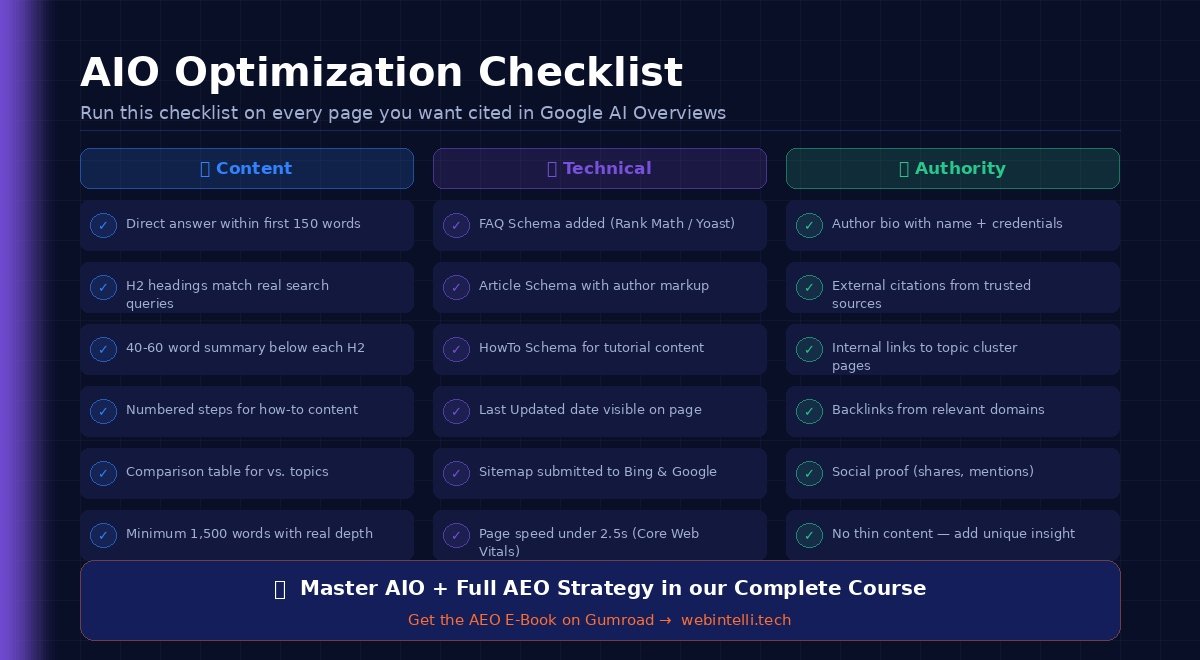
- ✓Googlebot and Bingbot fully allowed in robots.txt — not blocked
- ✓Page indexed in Google Search Console — no indexing errors
- ✓Core Web Vitals passing — LCP under 2.5s, CLS under 0.1, FID/INP under 200ms
- ✓Mobile-first design — fully responsive with no horizontal scrolling
- ✓HTTPS secured — no mixed content warnings
- ✓Canonical tags correct — no duplicate content diluting signals
- ✓Open Graph and Twitter Card meta tags present
- ✓Sitemap submitted to Google Search Console and Bing Webmaster Tools
- ✓Structured data validated via Google Rich Results Test — zero errors
- ✓Internal linking from high-authority pages to target AIO pages
7. Five Mistakes That Kill Your AIO Chances
| Mistake | Why It Blocks AIO | The Fix |
|---|---|---|
| Writing for rankings only | Keyword-dense content that doesn’t directly answer questions is unextractable by Gemini | Balance keyword optimization with clear, direct answer writing |
| No schema markup | Gemini can’t categorize or extract your content reliably without structured signals | Add FAQ, Article, and HowTo schema to every relevant page |
| Thin or shallow content | Pages under 800 words rarely provide enough topical depth for AIO consideration | Target 1,500–3,000 words with genuinely comprehensive coverage |
| Anonymous content | No author attribution is a hard EEAT failure, especially on YMYL topics | Add named author bios with credentials to all content |
| Ignoring content freshness | Outdated content — especially on fast-moving topics — is deprioritized by Gemini | Set a quarterly content review calendar and update “Last Updated” dates |
Your AIO Quick-Start Action Plan
- Audit your top 10 blog posts — do they have direct answer paragraphs under each H2? Fix the ones that don’t.
- Add FAQ schema to every post with a question-and-answer section (use Rank Math — it takes 5 minutes per post).
- Rewrite at least 3 H2 headings per post as questions that mirror real Google search queries.
- Add author bio sections with proper Person schema markup to all key content pages.
- Submit your sitemap to Bing Webmaster Tools if you haven’t — this is foundational for ChatGPT AEO too.
- Run Google Search Console’s Rich Results Test on your 5 most important pages and fix any schema errors.
- Update the “Last Updated” date on any article that hasn’t been touched in 6+ months — and actually refresh the content.
Google AI Overviews aren’t a trend — they’re the new SERP reality. The brands that adapt their content strategy now will own AI-generated visibility in their niche. The ones that don’t will watch their traffic migrate to whoever does.
Ready to dominate AI Search in 2026?
The Webintellitech AEO E-Book is the most practical, step-by-step guide to ranking in Google AI Overviews, ChatGPT, and Perplexity. Includes plug-and-play schema templates, content frameworks, a full 30-day action plan, and real optimization examples from live client sites.
← Blog #2: SEO vs AEO — What’s the Difference?
WebIntelliTech Team
SEO & AEO Strategists
Ready to improve your AI search visibility?
Get a free AI visibility audit and see exactly where you stand.