For decades, searching the internet meant one thing: type a query, get a list of blue links, click through, and find your answer buried somewhere on page two of someone’s blog.
That era is ending.
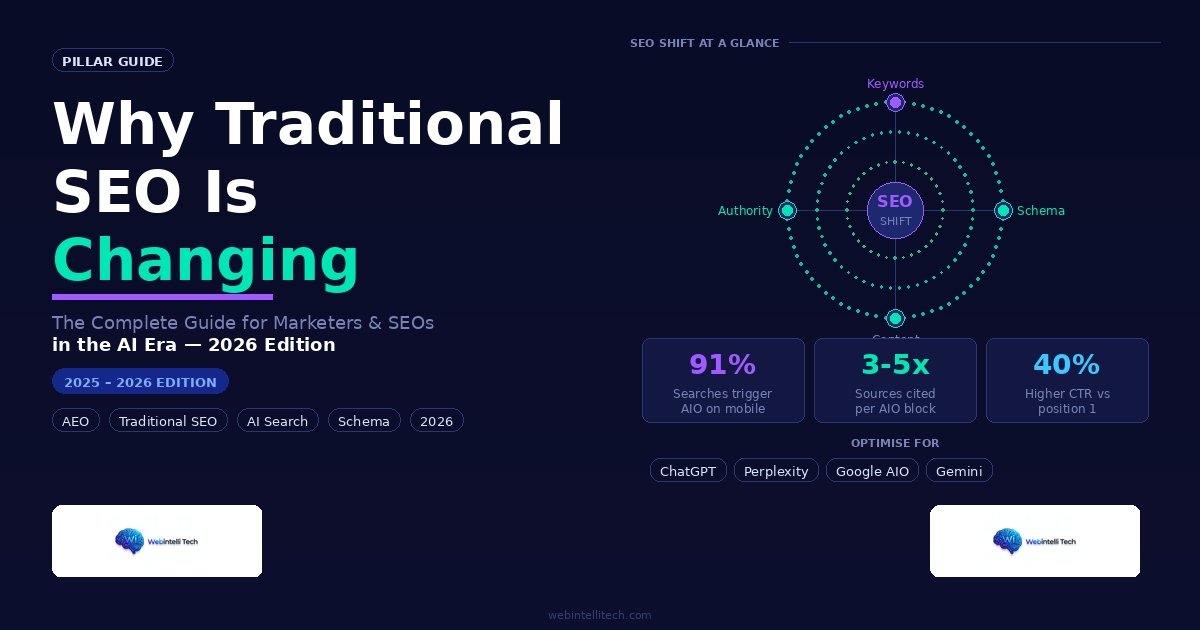
In 2026, hundreds of millions of people are getting their answers directly from AI search engines — systems that don’t just retrieve web pages, but actually read them, understand them, and synthesize a direct answer in plain language. No clicking required.
This shift is the biggest disruption in information discovery since Google itself. And if you run a website, write content, or work in digital marketing, understanding how these systems work isn’t optional — it’s survival.
Let’s break it all down.
What Is an AI Search Engine?
An AI search engine is a system that uses artificial intelligence — specifically, large language models (LLMs) — to understand natural language questions and return synthesized, conversational answers rather than a list of links.
Traditional search engines like Google (pre-AI) worked on keyword matching and ranking algorithms. You typed “best investment in India 2026” and got 10 links sorted by PageRank-style signals. You still had to do the reading.
AI search engines do the reading for you. They retrieve information from across the web, process it through a language model, and present a single, coherent answer — often with citations to the sources they used.
The key technologies powering them: Large Language Models (LLMs), Retrieval-Augmented Generation (RAG), and increasingly, real-time web browsing integration.
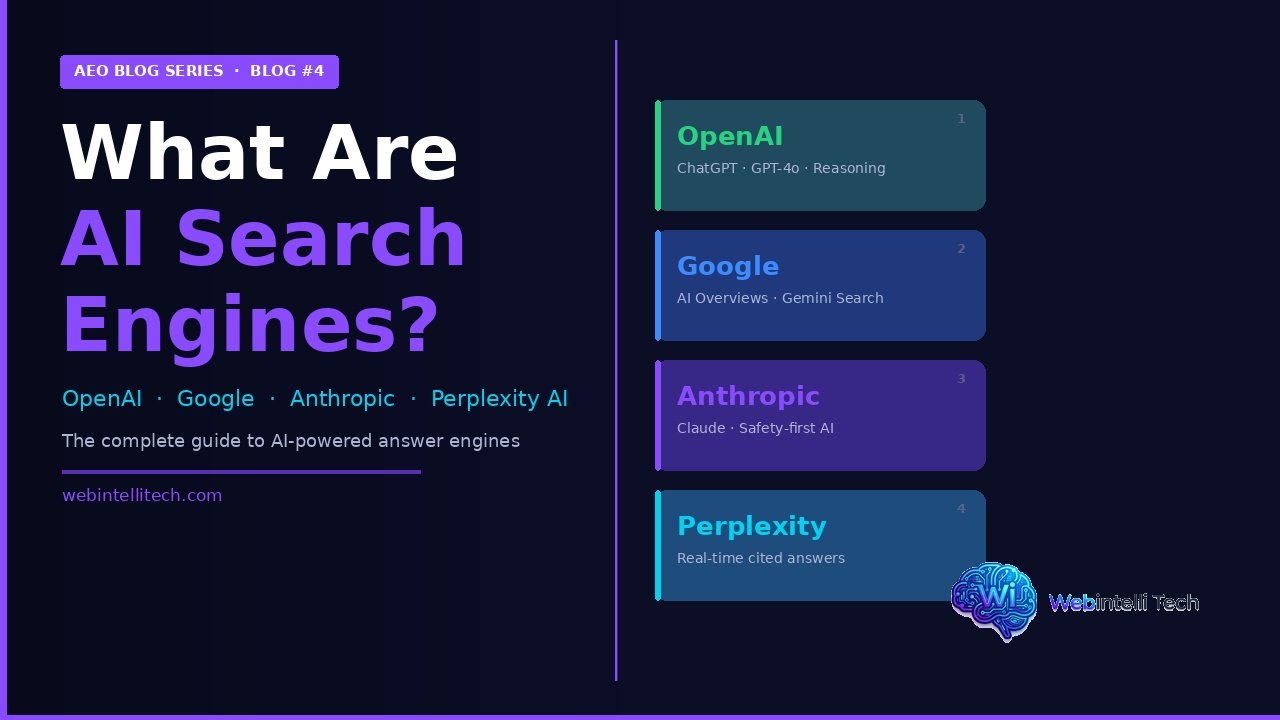
There are now four dominant players you need to know.
The 4 Major AI Search Engines in 2026
1. OpenAI — ChatGPT Search
OpenAI’s ChatGPT is the product that brought AI search to the mainstream. With over 800 million weekly active users, it has fundamentally changed what people expect from a search experience.
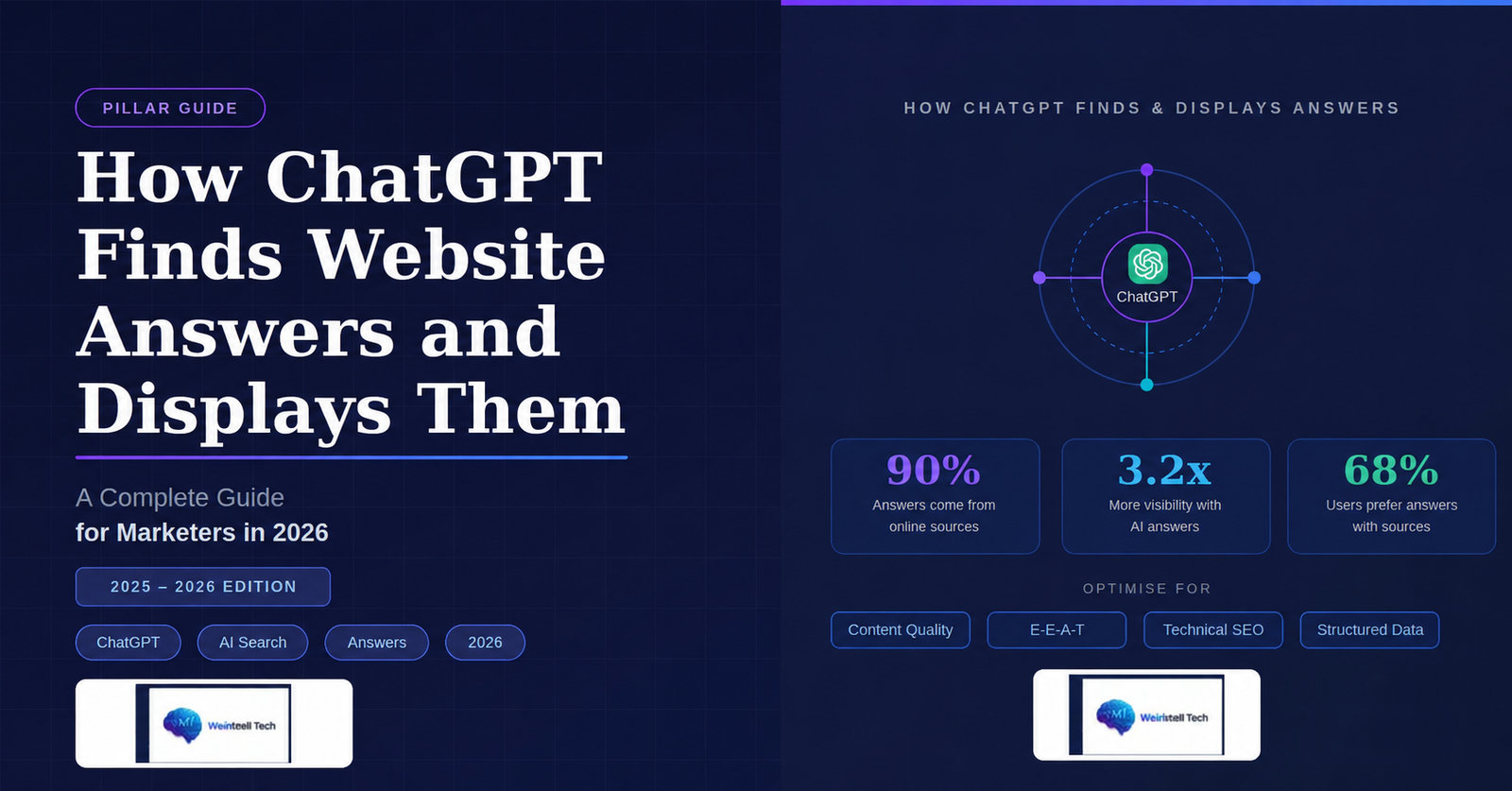
ChatGPT works in two modes. In its base form, it draws on knowledge absorbed during training — a vast dataset of web pages, books, and articles scraped before its knowledge cutoff. In browsing mode (powered by Bing), it retrieves live web pages in real time and cites its sources inline.
For website owners, this is critical: ChatGPT’s live browsing runs through Microsoft Bing. If Bing can’t find you, ChatGPT can’t cite you. This makes Bing Webmaster Tools a non-negotiable part of your AEO strategy.
ChatGPT excels at conversational, multi-turn queries. It remembers context across a conversation, can handle complex multi-part questions, and generates remarkably human responses. Its citations tend to favor pages that are authoritative, well-structured, and directly answer the query at the top of a section.
What this means for your AEO: Optimize for direct, question-answering content. Lead every section with a 40–60 word summary paragraph. Submit your sitemap to Bing. Add FAQ schema to every page.
2. Google — AI Overviews (Search Generative Experience)
Google was never going to sit still while OpenAI reinvented search. In 2024–2025, Google rolled out AI Overviews — a feature that appears at the very top of search results and provides an AI-generated summary answer before any organic links appear.
For SEOs, this has been the most disruptive development in years. Organic traffic to top-ranked pages has dropped for many query types, as users get their answers from the AI Overview without ever clicking through. This is often called zero-click search — and it’s accelerating.
Google’s AI Overviews are powered by its Gemini model and pull from pages that Google already ranks highly. Unlike Perplexity or ChatGPT, Google doesn’t need to go to Bing — it uses its own massive index. This means standard Google SEO and AEO overlap significantly for this platform.
Pages that appear in AI Overviews tend to have: high domain authority, structured content with clear headings, FAQ schema, EEAT signals (author credentials, about pages, external citations), and fast load times.
One key nuance: Google AI Overviews are more conservative than ChatGPT. They prefer established, high-authority sources and are slower to include newer, smaller websites. But when they do cite you, the traffic boost can be substantial.
What this means for your AEO: Traditional technical SEO still matters here. Focus on EEAT, structured data, and building domain authority over time. Getting into AI Overviews is essentially an extension of getting into position zero.
3. Anthropic — Claude
Anthropic’s Claude is a different kind of player. Where ChatGPT and Google AI Overviews are built for search-first experiences, Claude is positioned as a reasoning assistant — ideal for complex analysis, long-form synthesis, document review, and nuanced questions.
Claude is built on a safety-first research philosophy, making it particularly trusted in professional and enterprise contexts — law, medicine, finance, and research-heavy industries. It handles long context windows better than most models, meaning it can read and synthesize entire documents, not just short web pages.
From an AEO perspective, Claude sources information in a slightly different way. Its primary knowledge base comes from training data, but in the Claude.ai interface, users can attach documents and URLs for in-context reading. Anthropic has also made Claude available via API, meaning many third-party applications — from research tools to customer service bots — are powered by Claude under the hood.
This means your content can reach Claude users even when they’re not on Claude.ai directly. Any app or service built on the Anthropic API is a distribution channel for your content — if that content was comprehensive, credible, and widely cited enough to make it into Claude’s training data.
What this means for your AEO: For Claude specifically, long-form, deeply researched content outperforms thin quick-answer pages. Publish comprehensive guides, original research, and data-backed articles. These are the pieces most likely to be included in LLM training datasets and to surface when Claude is asked about your topic area.
4. Perplexity AI — The Research Engine
Perplexity AI is perhaps the most pure-form AI search engine of the four. Its entire product is built around one core experience: ask a question, get a cited, sourced answer in seconds.
Unlike ChatGPT (which is primarily a chatbot with search added) or Google (which is a search engine with AI added), Perplexity was designed from day one as an AI-native answer engine. Every response includes inline citations with source links. Users can follow up, refine, and dig deeper — all within a single, flowing conversation.
Perplexity uses a combination of its own web index and third-party search APIs to retrieve real-time information. It has a strong bias toward recent, specific, and well-cited content. Vague, generic pages rarely make the cut. Detailed, data-rich, expert-authored articles consistently get cited.
One thing that makes Perplexity particularly important for AEO: it’s enormously popular with researchers, students, professionals, and tech-savvy users — exactly the audience that tends to convert well for most B2B and premium B2C businesses.
What this means for your AEO: Perplexity rewards specificity. Create content that answers highly specific questions, includes real data and statistics, and is updated regularly. Use numbered lists, comparison tables, and step-by-step formats. These signal to Perplexity’s retrieval system that your content is high-value and easily extractable.
Why AI Search Engines Change Everything for Your Website
The combined reach of ChatGPT, Google AI Overviews, Claude, and Perplexity means that a growing percentage of information-seeking behavior now bypasses traditional blue-link search entirely. Users are getting answers without clicking.
This creates a paradox for content creators: you can be the source behind an AI answer that reaches millions of people, and never get a single pageview.
That’s why being cited — not just ranked — is the new success metric for content marketing. A citation in a ChatGPT or Perplexity answer drives brand awareness, builds authority, and in many cases still drives direct referral traffic through the source link.
The businesses and content creators who understand this shift early are the ones who will build lasting brand authority in an AI-first internet. The ones who keep optimizing purely for traditional keyword rankings will find their traffic increasingly squeezed by zero-click AI answers.
How Traditional Search vs. AI Search Works — Side by Side
| Factor | Traditional Search (Google) | AI Search (ChatGPT / Perplexity) |
|---|---|---|
| Result format | List of ranked links | Synthesized direct answer |
| User behavior | Click through to source | Read answer in-place |
| Key ranking signal | Backlinks + keywords | Clarity + structure + authority |
| Best content format | Long-form articles, pillar pages | FAQ, HowTo, direct-answer paragraphs |
| Schema that helps most | Title tag, meta description | FAQ schema, Article schema, HowTo schema |
| Traffic model | Click-based referral | Citation-based brand visibility |
| Update speed | Days to weeks | Hours to real-time (browsing mode) |
How to Optimize Your Website for AI Search Engines in 2026
Knowing the four major AI search engines is step one. Optimizing for them is step two. Here are the core principles:
- Write for questions, not just keywords. Every piece of content should be built around a primary question. Use that question in your H1, answer it in the first 150 words, and reinforce it in your meta description. AI engines are essentially question-answering machines — the more clearly your content maps to a question, the better.
- Use structured data (schema markup). FAQ schema, Article schema, and HowTo schema are not optional extras — they’re the machine-readable signals that tell AI crawlers exactly what your content is about and how to extract it. Every blog post you publish should have at minimum Article schema. Any page with Q&A content should have FAQ schema.
- Establish EEAT signals. All four major AI engines — and the training data they learned from — heavily weight Experience, Expertise, Authoritativeness, and Trustworthiness. This means: named authors with credentials, about pages, external citations of your work, and consistent publishing on a defined niche.
- Optimize for Bing, not just Google. This is the most underrated AEO action most marketers haven’t taken yet. Submit your sitemap to Bing Webmaster Tools at bing.com/webmasters. Verify your site. ChatGPT’s live browsing, Perplexity’s index, and several other AI tools rely on Bing’s index as a data source.
- Publish deep, specific content. Thin 500-word articles won’t make it into AI answers. The bar has risen. Aim for 1,500+ words, real data, specific examples, and direct actionable guidance. AI models prefer content that is comprehensive enough to be genuinely useful — not padded, but substantively deep.
- Update your content regularly. Freshness is a citation signal. Add a visible “Last Updated” date to all key pages. Revisit evergreen content quarterly to refresh statistics, add new context, and keep it current.
The Bottom Line
AI search engines aren’t the future — they’re the present. OpenAI’s ChatGPT, Google’s AI Overviews, Anthropic’s Claude, and Perplexity AI have collectively changed the way hundreds of millions of people find information every single day.
For website owners and content marketers, this creates both a risk and an opportunity. The risk: your traffic gets absorbed by zero-click AI answers if you don’t adapt. The opportunity: you become the cited source behind those AI answers — building brand authority at unprecedented scale.
The discipline that helps you capitalize on this opportunity is Answer Engine Optimization (AEO) — and the time to start is now.
🎓 Want the complete AEO playbook? My AEO Course e-book on Gumroad covers everything — schema markup, prompt-match content writing, Bing optimization, AI citation frameworks, and a 30-day action plan. Built for marketers, bloggers, and SEOs who want to dominate AI search in 2026. 👉 Get the AEO E-Book
Related Posts: ← Blog #1: What is AEO? Complete Guide for 2026 ← Blog #3: How ChatGPT Finds and Displays Website Answers
Tags: AI Search Engines, AEO, Answer Engine Optimization, ChatGPT SEO, Google AI Overviews, Perplexity AI, Claude AI
WebIntelliTech Team
SEO & AEO Strategists
Ready to improve your AI search visibility?
Get a free AI visibility audit and see exactly where you stand.